₹1.71 Lakh Crore Profit, 39 Lakh Crore Market Cap: What the Tata Group's FY26 Annual Report Actually Tells You
The Report That Tells the Full Story of India's Biggest Business Family
Every year, Tata Sons — the company that sits at the top of India's largest business group — releases its annual report. Most people never read it. But if you want to understand how India's most trusted conglomerate is doing, where it is heading, and what it is betting on next, this report is the most honest document available.
This year's report covers FY26 — the financial year that ended on March 31, 2026. And the numbers inside it tell a story that is both impressive and complicated at the same time.
First, Understand What Tata Sons Is
Before we get to the numbers, it helps to understand what Tata Sons actually is — because most people confuse it with TCS or Tata Motors.
Tata Sons is the holding company. Think of it as the parent company that owns large stakes in all the individual Tata businesses. It owns TCS. It owns stakes in Tata Motors, Tata Steel, Titan, Tata Power, Air India, Tata Electronics, and dozens of others. Tata Sons itself does not make cars or write software — it holds investments in the companies that do.
Tata Trusts — charitable trusts set up by the Tata family — own 66% of Tata Sons. The Shapoorji Pallonji group owns 18.4%. The rest is held by others.
Because Tata Sons is the parent of the entire empire, its annual report gives you a bird's-eye view of the health of the whole group — not just one company.
The Headline Numbers — A Very Good Year
Tata Sons reported a 21.8 per cent rise in its profit after tax to ₹31,961 crore in FY26, while revenue increased 9.1 per cent year-on-year to ₹42,367 crore. In simple language: Tata Sons earned ₹42,367 crore in revenue — money coming in from dividends, fees, and other income from its portfolio companies. After paying all its costs and taxes, it kept ₹31,961 crore as profit. That profit is 21.8% higher than last year.
At the group level, aggregate revenue rose 7.8 per cent to ₹16.24 lakh crore in FY26, while profit after tax surged 51.9 per cent to ₹1.71 lakh crore. So while Tata Sons itself earned ₹31,961 crore in profit, the combined profit of all Tata group companies together was ₹1.71 lakh crore — a 52% jump. That is a staggering number. It means the entire Tata empire — TCS, Tata Motors, Titan, Tata Steel, and all the others — together made ₹1.71 lakh crore of profit in one year.
The total market cap of all the listed Tata companies jumped from ₹13 lakh crore in FY20 to ₹39 lakh crore in FY26. In six years, the total stock market value of Tata's listed companies has tripled. That means if you had bought shares in all listed Tata companies six years ago, your investment would be worth three times as much today.
The board has recommended a final dividend of ₹1,10,717 per share. The dividend per share sounds absurdly large — over one lakh rupees per share. But that is because Tata Sons is a private company with a very small number of shares outstanding. The total dividend payout works out to approximately ₹4,474 crore going to shareholders — a very substantial payout.
N Chandrasekaran's Message — What the Chairman Is Saying
In his address to shareholders, Chandrasekaran said, "2026 has been a year defined by geopolitical conflicts and the unprecedented global AI investment cycle."
This is not just diplomatic language. The West Asia conflict affected oil prices, air travel, and global supply chains — all of which affected Tata companies that deal in aviation, steel, and automobiles. At the same time, the global AI boom created enormous opportunities — which Tata is trying to capitalise on through TCS, HCLTech partnerships, and its new semiconductor business.
Chandrasekaran said the group's revenue is now 2.1 times and profits 5.4 times their FY20 levels, reflecting sustained and significant turnaround efforts. This comparison to FY20 — the year before COVID hit — is important. Six years ago, the Tata Group had gone through a difficult period. Several businesses were struggling. Some were losing money. The group was also dealing with the aftermath of the Cyrus Mistry leadership dispute. Today, revenue has more than doubled and profits are 5.4 times higher. That is a genuine, significant transformation.
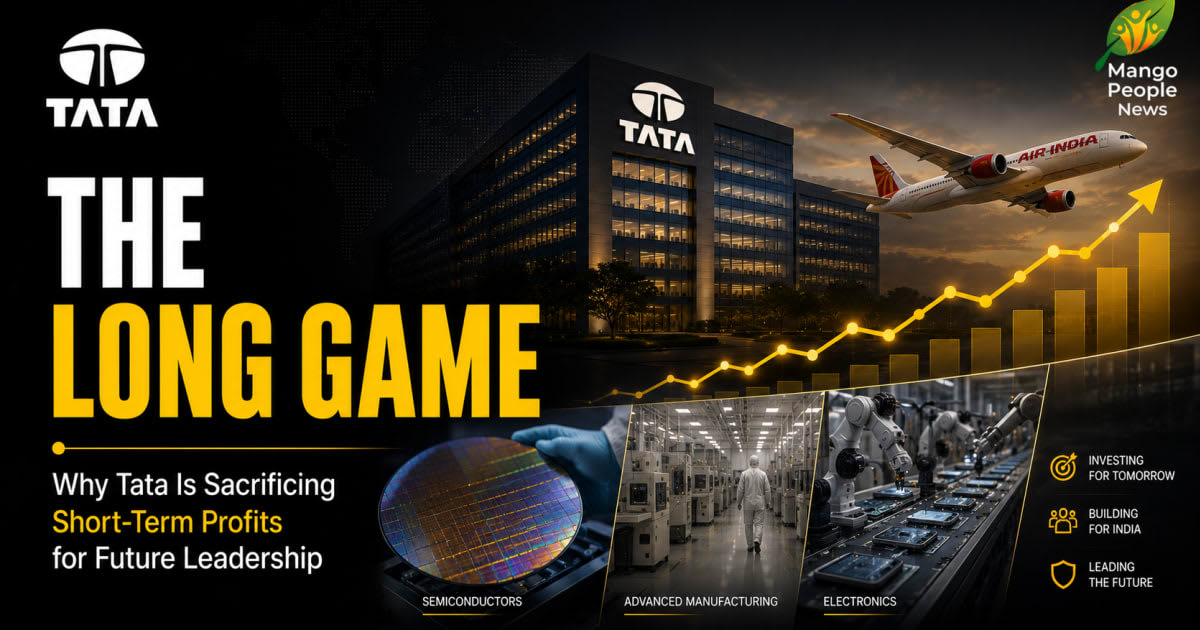
Chandrasekaran reflected on how the founders of the Tata Group took bets that "looked" risky but paid off. This is a signal about the new bets — Air India, semiconductor manufacturing through Tata Electronics, battery manufacturing through Agratas, and digital business through Tata Digital — which are currently losing money but which Chandrasekaran believes will pay off like the bets of the past.
The New Businesses — Losing Money Today, Betting on Tomorrow
This is the most interesting and honest part of the Tata Sons annual report. The group is investing heavily in several new businesses that are all currently making losses. These are not small losses either.
India's largest conglomerate has made huge investments in aviation, semiconductors, batteries, and digital commerce, which are still losing a cumulative amount of ₹30,000 crore a year.
₹30,000 crore of losses every year from new businesses. That is a big number. Let us understand what each of these is:
Air India: Tata bought Air India from the government in 2022 for ₹18,000 crore. It is investing billions more to upgrade the fleet, improve service, and turn the airline around. Air India remained under pressure, with its loss widening to ₹22,238 crore in FY26 from ₹10,859 crore a year earlier. The losses got worse, not better. Chandrasekaran attributed the difficult year to airspace closures, higher fuel costs triggered by the West Asia conflict, and foreign exchange pressures. In other words, external factors — the West Asia war, higher oil prices, closed airspace — made an already tough turnaround even harder in FY26.
Tata Electronics — Semiconductors and iPhones: Tata Electronics is manufacturing iPhones at its plants in Hosur and Bengaluru — the first Indian company to do so. It is also building a semiconductor packaging plant at Dholera in Gujarat. Both are enormous long-term investments that will not turn profitable for several years. But if India is to be a serious electronics manufacturing country, these are the investments that must be made.
Agratas — Batteries: Agratas is Tata's battery manufacturing company. It is building a gigafactory in Sanand, Gujarat, that will manufacture batteries for electric vehicles and energy storage. This is another multi-year investment. Battery manufacturing requires scale to become profitable, and that scale takes years to build.
Tata Digital: This includes the super-app Tata Neu and related digital commerce businesses. Despite significant investment and a large user base, Tata Neu has struggled to find its footing in a market dominated by quick commerce apps like Blinkit and Zepto.
These four loss-making businesses are the group's "bets on the future." The losses are real and significant today. But the Tata Group's bet — consistent with how it has made big calls historically — is that these will become highly profitable businesses 5 to 10 years from now.
The Established Businesses — Still Carrying the Empire
While the new businesses lose money, the group's established companies are performing exceptionally well.
TCS remains the crown jewel. India's largest IT company generates approximately ₹10,000+ crore in profit every quarter and pays Tata Sons billions in dividends — which is one of the main reasons Tata Sons itself can be so profitable despite the losses in new businesses.
Tata Motors — including JLR — has delivered strong performances, though JLR suffered a cyberattack in Q2 FY26 which resulted in a production pause for five weeks, although it has recovered with Q4 closing at near-normal production levels. Despite the cyberattack setback, JLR's recovery in Q4 showed the resilience of the business.
Titan Company — which makes Tanishq jewellery and Titan watches — has been one of the group's best performers, consistently growing revenues and profits while expanding internationally.
Tata Steel — the group's steel business across India and Europe — delivered record India production in FY26 while managing the Port Talbot restructuring in the UK.
Tata Power — targeting ₹1 lakh crore revenue by 2030 — continues to expand its renewable energy portfolio.
"All of our established businesses delivered strong performances this year, both in terms of revenue and profits," Chandrasekaran said.
The Dividend That Says Everything
Based on the company's performance, the board raised the dividend to ₹64,900 per share for FY25, up from ₹35,000 a share the previous year — a payout ratio of 6,490 per cent. (business-standard) And for FY26, that number has further risen to ₹1,10,717 per share.
The massive dividend per share tells you something important: Tata Sons generates so much cash from its portfolio — primarily from TCS dividends and share buybacks — that it has more than enough to fund its new business losses, maintain its balance sheet, and still pay very significant dividends.
This is the financial architecture of the Tata model: TCS and other mature businesses generate enormous free cash flows. Those cash flows are redistributed through Tata Sons as dividends — which go primarily to Tata Trusts, which then use that money to fund hospitals, educational institutions, and social welfare programmes across India. The group's philanthropy is not separate from its business — it is funded by the business, systematically and at scale.
The IPO Question That Keeps Coming Up
One thing that the annual report touches on is Tata Sons' own listing status.
The company also disclosed that it had applied to the Reserve Bank of India (RBI) in FY24 to voluntarily surrender its certificate of registration as a core investment company and continue as an unregistered CIC. The application remains under examination by the regulator. Tata Sons had repaid all its bank debt in FY24 in order to get itself declassified as a non-banking financial services-upper layer and avoid a listing, which the RBI has mandated for such entities.
Tata Sons very much does not want to be publicly listed. If it were listed, it would face quarterly earnings pressure, public scrutiny of every investment decision, and activist investor pressure to cut losses at Air India and Agratas rather than continuing to fund them for long-term value.
To avoid mandatory listing, Tata Sons repaid all its bank debt and applied to be reclassified. The RBI's response is still pending. This is one of the most watched regulatory decisions for the group — and the fact that it is still pending one year later creates ongoing uncertainty.
What the ₹30,000 Crore Loss Actually Means for India
The ₹30,000 crore that Tata's new businesses are losing every year is not just corporate spending. It is economic activity.
Air India's losses are partly because it is spending heavily to hire pilots, buy aircraft, train cabin crew, and upgrade airports. That spending employs thousands of people and supports the broader aviation ecosystem.
Tata Electronics' semiconductor and iPhone manufacturing losses are investment in factories that will eventually employ tens of thousands of workers and make India more self-reliant in critical technology.
Agratas' battery factory losses are investment in infrastructure that will eventually power India's electric vehicles and clean energy future.
In other words, when Tata loses ₹30,000 crore building these businesses, India gains industrial capacity, employment, and technological capability. The losses are a cost today for a benefit that arrives years from now — for both the Tata Group and for India.
This long-term thinking — the willingness to absorb large losses for large long-term gains — is what has historically differentiated the Tata Group from other Indian conglomerates. And the FY26 annual report, with its honest disclosure of these losses alongside the celebration of the established businesses' performance, reflects that same philosophy being applied in the current era.
The Simple Summary
The Tata Group had a very good year in FY26 by the numbers. The entire group earned ₹1.71 lakh crore in profit — 52% more than last year. The stock market value of all listed Tata companies reached ₹39 lakh crore — three times what it was in FY20. TCS, Titan, Tata Steel, and Tata Power all performed strongly.
But the honest picture also includes big new losses. Air India lost ₹22,238 crore. Semiconductor manufacturing, battery factories, and digital commerce are all losing money. Together, the new businesses cost the group ₹30,000 crore per year.
Chairman Chandrasekaran's message is: trust the process. The founders of the Tata Group made bets that looked risky and paid off over decades. The current bets — aviation, semiconductors, batteries, digital — are the same kind of long-term commitment.
The group's strength is that TCS and other mature businesses generate more than enough cash to fund both the losses and the dividends. Tata Sons itself earned ₹31,961 crore in profit and recommended a dividend of ₹1,10,717 per share to its shareholders — primarily the Tata Trusts, which will use that money to fund schools, hospitals, and welfare programmes across India.
That is the Tata model. Profit used for philanthropy. Losses accepted for long-term national benefit. And 150+ years of doing this consistently — which is why the group remains India's most trusted business name.

Nikunjj Jhawar is a Chartered Accountant (CA) and Chartered Financial Analyst (CFA) with nearly two decades of experience in the financial services industry. Having worked with global institutions such as HSBC and Credit Suisse in investment-related roles, he brings deep expertise in finance and markets. He is the Founder of mangopeoplenews.com, where he focuses on making complex topics in finance, markets and business accessible and relevant to everyday readers.