

Punjab Grill's Founder Is Weighing an Exit — and Every PE Firm in India Should Be Paying Attention

Amit Burman has been building Lite Bite Foods for over two decades. The Dabur family scion founded the company in 2001 with a vision straightforward enough to explain in one sentence: India needed a serious, organised, multi-brand restaurant group that could operate everywhere from airport food courts to premium dining rooms, across Indian and international cuisines, at every price point. Over the years, he built exactly that.
Now, sources indicate the Burman family is weighing a majority stake sale — potentially bringing in a new controlling shareholder to take what has quietly become one of India's most comprehensive restaurant portfolios into its next phase.
WHAT LITE BITE FOODS ACTUALLY IS
Most people know Punjab Grill — the upscale North Indian restaurant that has become a go-to for everything from business lunches to family celebrations across Delhi-NCR, Mumbai, Bengaluru, and beyond. But Punjab Grill is just one of 18-plus brands operating under Lite Bite Foods' umbrella.
The portfolio spans a genuinely impressive range. Punjab Grill handles premium North Indian. YouMee brings pan-Asian — sushi, dim sum, ramen — to malls and now tier-2 cities. Asia Seven covers fine-dining Asian. Zambar handles South Indian. Street Food by Punjab Grill is the mass-market, high-volume QSR play. Baker Street runs café and bakery formats. 212 All Day and Bar Bar cover all-day dining and casual bar formats — the latter acquired from Phoenix Mills' Bellona Hospitality arm in 2019.
The airport business deserves particular attention. LBF holds master concession rights at multiple Indian airports including Indore, Ahmedabad, Coonoor, Calicut, and Bhubaneshwar, with an existing presence in Jammu and Pune as well. Airport F&B is structurally different from high-street restaurant operations — captive footfall, higher spend per transaction, and lower sensitivity to economic cycles — and LBF's airport book represents a stable, annuity-like revenue stream alongside its more cyclical restaurant business.
Total outlets across all brands: approximately 145–155 currently active, with a historical peak of around 180+ before Covid-era consolidation.
For FY25, Lite Bite Foods reported revenue of ₹735.8 crore — up 12% year-on-year — making it one of the larger unlisted restaurant companies in the country.
WHY THE BURMAN FAMILY IS LOOKING AT AN EXIT NOW
Timing matters in any M&A conversation, and the current timing for a Lite Bite stake sale makes sense from multiple angles.
Indian restaurant sector valuations have been elevated. Jubilant FoodWorks — operator of Domino's India — trades at premium multiples. Devyani International, which runs KFC and Pizza Hut, has been a strong performer. Restaurant Brands Asia, the Burger King India operator, has listed and matured as a public company.
Speciality Restaurants, which operates Mainland China and Oh! Calcutta, continues as a listed entity. The public market benchmarks give private equity buyers a clear reference point for what a quality restaurant portfolio looks like when valued transparently.
Amit Burman had discussed IPO plans on multiple occasions over the past several years — telling bankers and journalists at various points that the company was "toying with the idea" of going public, with internal discussions reportedly advanced at various moments. An IPO never materialised. A strategic majority sale achieves a similar capital event for the promoter family, potentially at a more attractive valuation than the public market would assign to a company of LBF's size and scale, while also bringing in a partner with the capital and expertise to fund the next phase of expansion.
For a Dabur family member managing investments across multiple businesses, a partial or full monetisation of a hospitality asset in a favourable market environment is also simply prudent capital allocation.
THE M&A CONTEXT: INDIA'S RESTAURANT SECTOR IS CONSOLIDATING FAST
Lite Bite Foods' potential sale doesn't happen in isolation. India's restaurant and food service sector has seen a flurry of M&A activity in recent years, driven by PE firms looking for quality branded portfolio plays and operators seeking the capital to expand beyond their organic growth rate.
Lighthouse Canton acquired a stake in Impresario Entertainment and Hospitality — the company behind Social, Smoke House Deli, and Salt Water Cafe — in a deal that valued one of India's most successful casual dining portfolios at a significant premium. Westbridge Capital has backed multiple food service companies. Even platform players like Eternal (the Zomato parent) have shown acquisitive instincts in the food ecosystem through their District restaurant booking platform.
On the global side, the India restaurant market's rapid growth — projected to cross $97 billion by 2030 — has drawn attention from international PE firms that had previously passed over the sector as too fragmented. The consolidation playbook is well understood: acquire a strong portfolio operator with multiple proven brands, invest capital to accelerate expansion, and either list the combined entity or sell to a strategic buyer in three to five years.
Lite Bite Foods, with its 18-plus brands, its airport concession business, its mix of premium and mass-market formats, and its ₹735 crore revenue base, is exactly the kind of platform acquisition that makes strategic sense for a buyer looking to build scale in Indian dining quickly.
WHAT A BUYER WOULD ACTUALLY BE ACQUIRING
Beyond the brand portfolio and the revenue, any buyer of a majority stake in Lite Bite Foods would be acquiring three things that are considerably harder to replicate than a restaurant menu.
First, airport concession rights — a sticky, defensible revenue stream that requires competitive bidding and operational credibility to win, and that provides base-load revenue regardless of what the high-street restaurant market is doing in any given quarter.
Second, a multi-format, multi-cuisine operating capability that almost no other Indian restaurant group has built at comparable breadth. Running Punjab Grill at one end and Street Food by Punjab Grill at the other, within the same organisation, requires genuinely different supply chains, kitchen configurations, staff profiles, and financial models. That capability is valuable and was built over years.
Third, Amit Burman himself — whose network, industry relationships, and hospitality instincts have been the common thread across two decades of LBF's evolution. Whether a majority sale includes his ongoing involvement — as chairman, as an advisor, or not at all — will significantly shape the valuation and the transition plan.
WHAT COMES NEXT
No formal process has been announced. Sources describe the family as "weighing" options rather than having launched a structured sale. That language suggests conversations may be at an exploratory stage — investment banks being sounded out, preliminary interest gauged from PE funds, internal deliberations underway on valuation expectations and deal structure.
The enterprise value range bandied about in industry circles is approximately ₹1,000–1,500 crore for the business — a figure that implies a price-to-sales multiple of roughly 1.5–2x on trailing revenues, broadly in line with comparable Indian restaurant platform transactions.
PE firms that have shown consistent interest in the Indian F&B and QSR space — Samara Capital, General Atlantic, Lighthouse Canton, and Westbridge among others — would be the natural first-call list for any formal process. A strategic acquirer from the food or hospitality sector is also a possibility, though rare in Indian restaurant M&A at this level.
For India's restaurant industry, this transaction — if it happens — would be the clearest signal yet that the consolidation wave is now reaching the upper tier of the branded dining segment. Punjab Grill was never just a restaurant. It was, for many Indians, a benchmark for what premium North Indian dining in an organised setting should look and feel like. Whoever buys it inherits that positioning — and the responsibility of preserving it.
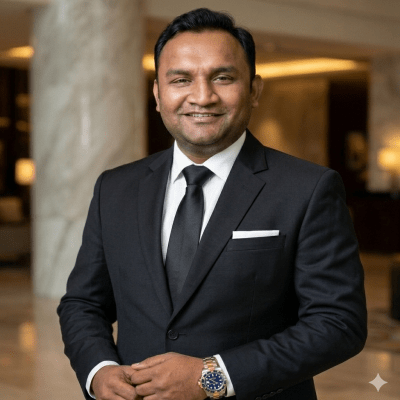
Nikunjj Jhawar is a Chartered Accountant (CA) and Chartered Financial Analyst (CFA) with nearly two decades of experience in the financial services industry. Having worked with global institutions such as HSBC and Credit Suisse in investment-related roles, he brings deep expertise in finance and markets. He is the Founder of mangopeoplenews.com, where he focuses on making complex topics in finance, markets and business accessible and relevant to everyday readers.
