

OYO IPO Under The Lens: How Sustainable Is PRISM's ₹748 Crore Profit?
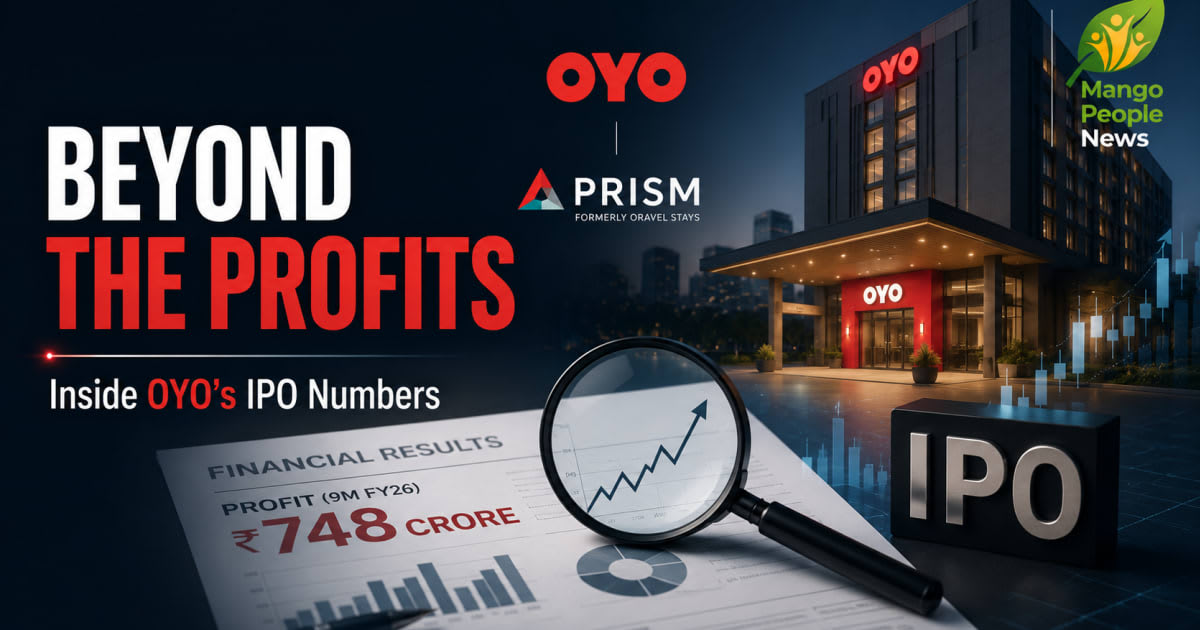
As OYO parent PRISM prepares for its much-awaited stock market debut, one number has grabbed investors' attention—a net profit of ₹748 crore for the first nine months of FY26.
On the surface, the figure signals a dramatic turnaround for the hospitality technology company. But a closer reading of its IPO filings suggests that investors may need to look beyond the headline profit before assessing the company's valuation.
The key question is not whether PRISM has become profitable—but how much of that profit comes from its core operations and whether it can be sustained after listing.
A Strong Turnaround Ahead Of The IPO
PRISM, formerly known as Oravel Stays, has filed updated IPO papers with market regulator SEBI to raise ₹6,650 crore through an entirely fresh issue of shares. Unlike many startup IPOs, there is no Offer for Sale (OFS), meaning all proceeds will go to the company. For the nine months ended December 31, 2025, the company reported:
- Net profit: ₹748 crore
- Revenue from operations: ₹6,941 crore
- EBITDA: ₹2,127 crore
Notably, revenue during the first nine months of FY26 has already exceeded the company's entire FY25 revenue of ₹6,259 crore, highlighting strong business momentum.
Why Are Analysts Looking Beyond The Profit Figure?
While the reported profit appears impressive, analysts believe investors should examine the composition of earnings rather than relying solely on the headline number.
Companies preparing for IPOs often experience gains from exceptional items, accounting adjustments, tax benefits or one-off transactions that may not recur in future years. For long-term investors, the more important questions include:
- Is revenue growth being driven by core operations?
- Are margins improving sustainably?
- Can earnings continue growing after the IPO?
- How dependent is profitability on non-recurring gains?
These factors will ultimately determine whether current earnings are repeatable.
Operations Show Signs Of Strength
Despite questions around earnings quality, PRISM's operating performance has strengthened considerably.
The company has expanded beyond its traditional budget hotel business and now operates 43 brands across more than 35 countries. Its network includes:
- 24,303 hotels
- 124,668 homes
- 144,583 listings
- 14,937 storefronts in India
The business has also become more geographically diversified than in previous years.
Motel 6 Acquisition Is Changing The Business Mix
One of the biggest contributors to PRISM's recent growth has been the acquisition of G6 Hospitality, which owns the Motel 6 and Studio 6 brands in the United States.
The US market has emerged as the company's largest growth engine. According to the IPO documents:
- US Gross Booking Value (GBV) rose to ₹12,022.51 crore during 9MFY26.
- The US business contributed more than 52% of global GBV.
This diversification reduces PRISM's dependence on India while providing exposure to a more mature hospitality market.
Balance Sheet Also Matters
A large portion of the IPO proceeds is expected to strengthen the company's balance sheet. Out of the ₹6,650 crore fresh issue:
- ₹4,987.5 crore is proposed to be used for repayment or prepayment of borrowings.
- The remaining funds will support general corporate purposes.
Lower debt could improve profitability by reducing finance costs over time.
What Investors Should Watch
Rather than focusing exclusively on the ₹748 crore profit, investors may want to track several key indicators after listing:
- Growth in revenue from core operations
- EBITDA margins
- Occupancy and booking trends
- Performance of the US business
- Debt reduction following the IPO
- Sustainability of earnings without exceptional gains
These metrics will provide a clearer picture of PRISM's long-term financial health.
Why It Matters
OYO has spent years restructuring its business after rapid global expansion and multiple delays to its public listing plans.
The latest financial results indicate meaningful operational progress, but the IPO also places greater emphasis on transparency and the durability of earnings.
Institutional investors are likely to evaluate not just how much profit the company has reported, but whether that profitability can be consistently maintained in the years ahead.
The Bottom Line
PRISM's reported ₹748 crore profit marks an important milestone in OYO's journey towards becoming a publicly listed company.
The business appears stronger than during its earlier IPO attempts, supported by higher revenues, improved operating performance and international expansion.
However, as with any IPO, headline profits tell only part of the story.
For investors, understanding the quality and sustainability of earnings may prove more important than the size of the reported profit itself.

Nikunjj Jhawar is a Chartered Accountant (CA) and Chartered Financial Analyst (CFA) with nearly two decades of experience in the financial services industry. Having worked with global institutions such as HSBC and Credit Suisse in investment-related roles, he brings deep expertise in finance and markets. He is the Founder of mangopeoplenews.com, where he focuses on making complex topics in finance, markets and business accessible and relevant to everyday readers.
