One X Post That Said Everything: Why Uday Kotak's Google Comparison Is the Most Uncomfortable Truth in Indian Business Right Now
Uday Kotak has been a careful man his entire career. As a banker, he says less than he knows. As a business commentator, he chooses his words with the precision of someone who understands that every sentence carries weight. Which is why, when he posted four lines on X on June 2, 2026, the Indian business community sat up and paid attention.
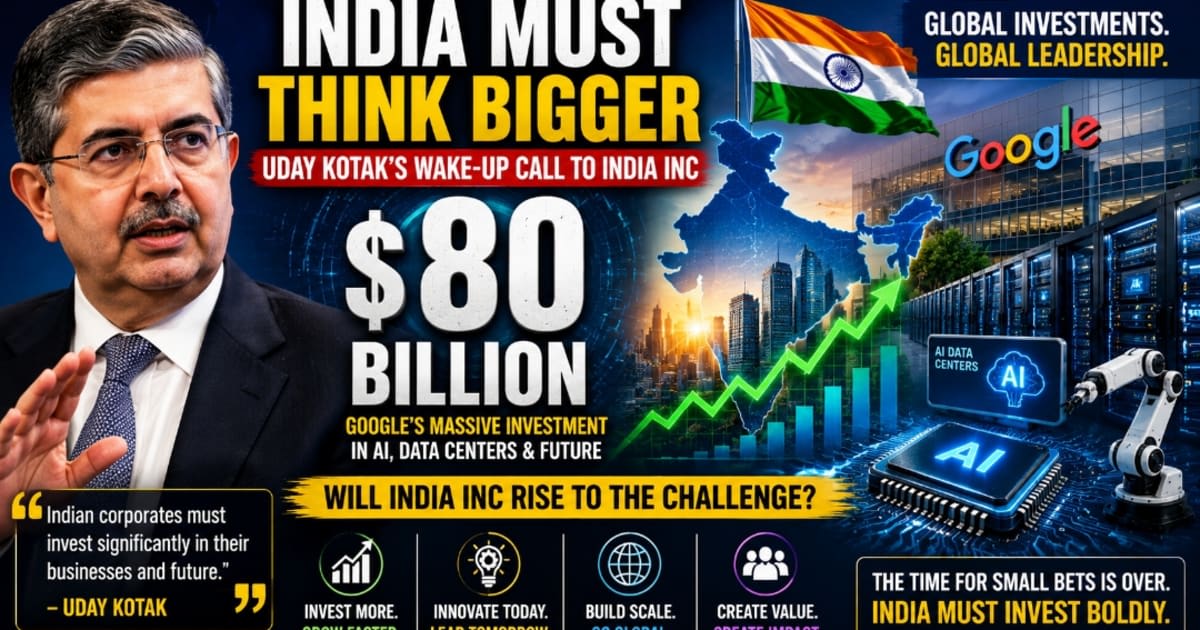
"Google which is cash surplus, just announced an additional capital raise of $80 bn. Google annual profit is $160 bn, last quarter $62 bn, and market cap $4.5 trillion. That is close to total profits and market cap of all Indian listed companies put together. It's a wake up call…"
That was it. No elaboration needed. The mathematics did the work.
WHAT GOOGLE IS ACTUALLY DOING
Alphabet announced one of the world's largest equity fundraising exercises aimed at strengthening its AI infrastructure and computing capabilities. The company said it plans to raise $80 billion through a combination of public offerings and a private placement deal.
The fundraising includes a $10 billion share sale to Berkshire Hathaway — the investment group long associated with Warren Buffett — alongside $40 billion in at-the-market stock sales and $30 billion in underwritten offerings.
The proceeds will go toward AI infrastructure: data centres, GPUs, cooling systems, fibre, and the physical architecture of the next decade of computing. Google is spending more on AI infrastructure in a single fundraise than India's entire digital public infrastructure investment over the past decade.
"It's a wake-up call to all companies to invest in the future, whatever the present may be. Now that IPL is done and dusted, time for India to focus on the business of business," Kotak wrote — the IPL reference a pointed reminder that India spent three months consumed by cricket while the most consequential capital deployment in technology history was being assembled.
THE COMPARISON THAT SHOULD MAKE EVERY BOARDROOM UNCOMFORTABLE
The Kotak comparison deserves to be repeated precisely because its bluntness is its power. Google's annual profit of $160 billion and market cap of $4.5 trillion are collectively close to the total profits and market cap of every listed company in India — combined. A single American technology company, built on search and advertising, has accumulated more financial firepower than the entire formal economy of the world's most populous nation as represented by its public markets.
And that company, already the most cash-generative enterprise in human history, has decided to raise $80 billion more — not because it needs to, but because it believes the AI race will be won by whoever deploys the most compute first and most effectively.
The strategic implication for Indian companies is uncomfortable and unavoidable. In a world where the technology competition is being fought at a scale that requires $80 billion cheques, the Indian corporate sector's tendency toward capital conservatism — deploying free cash flows into buybacks, incremental expansions, and dividend distributions — looks increasingly like a strategic choice to cede ground rather than compete.
WHAT INDIA IS DOING — AND WHY IT IS NOT ENOUGH YET
To be fair, India is not standing still. Reliance Industries and Jio have committed $109.8 billion over seven years to AI and data infrastructure. Adani Group has committed $100 billion for AI data centres through 2030. The India AI Impact Summit in February 2026 generated commitments exceeding $150 billion from global and domestic players combined. But commitments made over seven to ten years are not the same as $80 billion deployed in a single capital raise by one company in one quarter. The speed differential matters as much as the absolute amounts.
Kotak's point is not that India cannot compete. It is that Indian companies — particularly the large-cap profitable ones sitting on strong balance sheets and predictable cash flows — need to shift their capital allocation philosophy from return-optimisation to future-investment. The companies that will define India's next economic chapter are the ones deciding right now what to build with the capital they have.
The IPL is over. The question, as Kotak frames it, is whether Indian business is paying attention to the game that actually matters.

Nikunjj Jhawar is a Chartered Accountant (CA) and Chartered Financial Analyst (CFA) with nearly two decades of experience in the financial services industry. Having worked with global institutions such as HSBC and Credit Suisse in investment-related roles, he brings deep expertise in finance and markets. He is the Founder of mangopeoplenews.com, where he focuses on making complex topics in finance, markets and business accessible and relevant to everyday readers.