From Backing Google in a Garage to Fueling India’s Space Dream: Meet Investor Ram Shriram

Nearly three decades after writing one of Silicon Valley’s most legendary early-stage cheques to a tiny startup called Google, venture capitalist Ram Shriram is now backing another ambitious bet—India’s private space sector.
Shriram’s venture firm, Sherpalo Ventures, recently co-led a $60 million funding round in Skyroot Aerospace, helping the Hyderabad-based rocket startup become India’s first space-tech unicorn with a valuation of around $1.1 billion. The development marks a symbolic moment for India’s startup ecosystem: one of the earliest believers in Google is now backing India’s push into commercial space launches.
The Investor Who Backed Google Before the World Knew It
Ram Shriram is widely known in the global technology ecosystem for being among the earliest investors in Google.
Back in 1998, when Larry Page and Sergey Brin were still building Google from a garage, Shriram reportedly wrote one of the company’s first external cheques. That early investment eventually became one of the most successful venture bets in technology history.
Over the years, Shriram became deeply connected with Silicon Valley’s startup ecosystem and later joined Google’s board during its formative years. His reputation as a long-term technology investor has since made him one of the most respected figures in venture capital circles.
Now Betting on India’s Space Sector
Shriram is now turning his attention toward India’s rapidly emerging private space industry.
Through Sherpalo Ventures, he participated in Skyroot Aerospace’s latest funding round alongside:
Singapore sovereign wealth fund GIC
Global asset manager BlackRock
Existing investors and family offices
The investment has pushed Skyroot’s valuation to around $1.1 billion, officially making it India’s first unicorn in the space-tech sector.
Why Skyroot Aerospace Matters
Founded in 2018 by former ISRO scientists Pawan Kumar Chandana and Naga Bharath Daka, Skyroot Aerospace has become one of the most prominent names in India’s private space race.
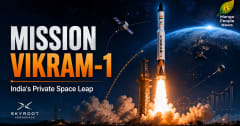
The company gained national attention after launching Vikram-S, India’s first privately developed rocket, in 2022. It is now preparing for the launch of Vikram-1, expected to become India’s first privately built orbital rocket.
Why Global Investors Are Interested
The funding round reflects growing global confidence in India’s private space ecosystem.
Several factors are attracting investors:
1. India’s Cost Advantage
India can potentially offer significantly cheaper launch services compared to many global competitors.
2. Government Support
India opened its space sector to private companies in 2020, allowing startups access to ISRO facilities and infrastructure.
3. Rising Global Satellite Demand
Demand for satellite launches is increasing due to:
Communications
Defence applications
Earth observation
Internet constellations
AI-driven data systems
4. Strong Engineering Talent
India’s deep aerospace and software talent pool creates a strong foundation for space startups.
Shriram Will Join Skyroot’s Board
As part of the investment, Ram Shriram is also expected to join Skyroot Aerospace’s board. That could be strategically important because Shriram brings:
Silicon Valley scaling expertise
Global investor relationships
Deep technology company experience
Long-term strategic guidance
For an Indian startup entering a capital-intensive industry like space, such mentorship can be valuable beyond funding alone.
The Rise of India’s Private Space Economy
For decades, India’s space programme was dominated almost entirely by ISRO. But policy reforms in recent years have opened the door for private participation. This has led to the emergence of startups working across:
Launch vehicles
Satellites
Space data analytics
Defence applications
Manufacturing and propulsion systems
Skyroot’s unicorn milestone could encourage larger pools of venture and institutional capital to enter the sector.
Why This Moment Is Symbolic
There is a broader narrative behind the story.
Ram Shriram once backed the internet revolution before it became mainstream. Today, he appears to be making a similar long-term bet on India’s commercial space ecosystem.
That parallel is attracting attention because many investors believe space technology could become one of the next major global innovation cycles.
Challenges Still Remain
Despite the excitement, the space business remains extremely difficult. Skyroot still faces major execution challenges:
Successful orbital launches
Manufacturing scale-up
Reliability and safety standards
Competition from global launch companies
Capital-intensive operations
Becoming a unicorn is only the beginning—the real test will be commercial execution.
What Investors Will Watch Next
Key milestones ahead include:
Successful Vikram-1 orbital launch
Increased launch frequency
Commercial customer acquisition
International partnerships
Revenue scaling
If Skyroot executes successfully, it could become one of the most important private aerospace companies to emerge from India.
Final Takeaway
Ram Shriram’s journey—from writing Google’s early cheque to backing India’s first space-tech unicorn—highlights how venture capital often follows transformative technological shifts before the broader market notices them.
His latest bet on Skyroot Aerospace signals growing confidence that India’s private space sector may be entering its defining decade. And if the sector scales as optimists expect, Skyroot’s unicorn milestone may only be the beginning of a much larger space-tech story for India.

Nikunjj Jhawar is a Chartered Accountant (CA) and Chartered Financial Analyst (CFA) with nearly two decades of experience in the financial services industry. Having worked with global institutions such as HSBC and Credit Suisse in investment-related roles, he brings deep expertise in finance and markets. He is the Founder of mangopeoplenews.com, where he focuses on making complex topics in finance, markets and business accessible and relevant to everyday readers.