

GMR Airports Just Turned Profitable, Opened Bhogapuram, and Is Expanding Nagpur — The Distance Between It and Adani Has Never Been Wider

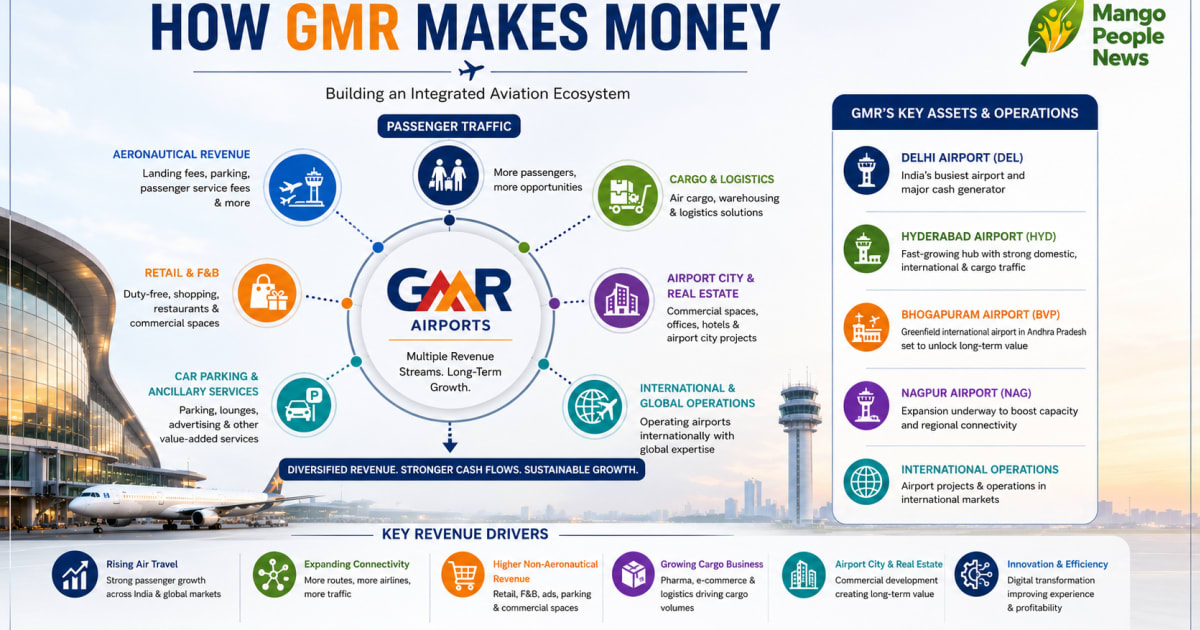
There is a simple way to understand what has happened at GMR Airports over the past eighteen months. In Q4 FY25, the company posted a consolidated loss. In Q4 FY26, it posted a consolidated profit of ₹400 crore — a swing of several hundred crore in a single year, driven by a Delhi tariff revision that is still working its way through the income statement with more to give.
Simultaneously, India's largest private airport operator opened a brand-new international airport in Visakhapatnam, launched a ₹300 crore expansion at Nagpur, and watched Paris-based ADP reduce its stake in a deal that confirmed the entire group's valuation at over $6 billion. And every week, the gap between GMR and its primary rival — Adani Airport Holdings — widened a little further.
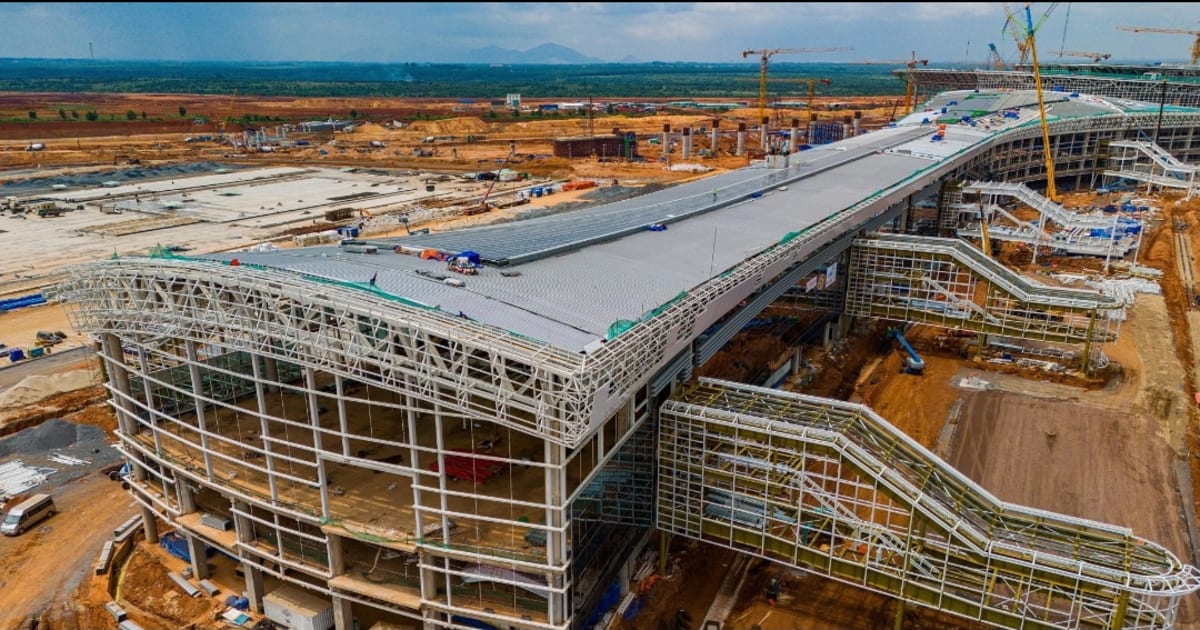
Bhogapuram International Airport — India's Newest Gateway Is Open
On July 2, 2026, Union Civil Aviation Minister Ram Mohan Naidu announced that Bhogapuram International Airport had received its aerodrome licence — the formal regulatory clearance required before any airport can begin commercial operations. The minister confirmed the airport is set for launch, ending years of construction and anticipation.
The Bhogapuram project is a 40-year DBFOT concession held by GMR Visakhapatnam International Airport Limited, covering a 2,200-acre site designed to handle 6 million passengers annually in its initial phase. Commercial operations — beginning with domestic flights — are expected to commence within weeks of the aerodrome licence being issued, with international route approvals to follow. The airport received its aerodrome licence, with the minister stating it is "set for launch."
The significance of Bhogapuram extends beyond its passenger numbers. It replaces the existing Visakhapatnam Airport, which has been operating beyond capacity, and positions Andhra Pradesh's most important industrial corridor — including the Krishnapatnam port, the expanding MSEZ, and multiple data centre campuses nearby — with a world-class air gateway for the first time. For GMR, it is the third major airport it has opened in three years, following the Goa-Mopa Airport in 2023 and now Bhogapuram in 2026.
What makes the Bhogapuram completion particularly notable is that construction came in approximately six months ahead of the original contractual deadline — a remarkable achievement for greenfield Indian airport infrastructure, which has a historical tendency to run well over budget and well past deadline. The early delivery reduces interest-during-construction costs and brings revenue generation forward by two to three quarters relative to what had been modelled.
Nagpur Airport — ₹300 Crore Expansion Signals GMR's Tier-2 Ambitions
While Bhogapuram captured the aviation headlines, GMR simultaneously launched a ₹300 crore expansion plan for Dr. Babasaheb Ambedkar International Airport in Nagpur — the central India hub that the group operates under a concession agreement with the Airports Authority of India.
The Nagpur expansion plan covers terminal infrastructure upgrades, cargo handling enhancement, and improved airside facilities for wider-body aircraft operations. Nagpur handled 2.89 million passengers in FY25, with cargo growing 12.8% year-on-year — strong growth from a relatively underpenetrated hub that sits at the geographic centre of India and is increasingly recognised as a natural logistics and cargo gateway for central India's manufacturing belt.
The ₹300 crore investment signals something important about GMR's strategy. While Adani Airport Holdings has concentrated its expansion on the trophy assets — Mumbai, Navi Mumbai, Ahmedabad — GMR is simultaneously investing in tier-2 airport development that serves both the commercial aviation market and the growing cargo logistics opportunity that India's manufacturing push is creating. Nagpur's eventual development as a cargo hub alongside a passenger terminal gives GMR revenue diversification that pure-play passenger airport operators lack.
Q4 FY26 Financials — Profitability Arrives, Finally
The financial results for Q4 FY26 confirmed what the Delhi tariff revision had promised: GMR Airports can be a profitable business at scale.
Consolidated profit after tax for Q4 FY26 stood at ₹400 crore — the company's strongest quarterly performance and a decisive break from the loss-making trajectory that had characterised the business through most of its post-COVID recovery period. The full year performance showed revenue growing substantially, driven primarily by the 69% increase in aeronautical yield per passenger at Delhi Airport following the Control Period 4 tariff revision.
The CP4 tariff change — which raised Delhi's aeronautical yield from approximately ₹277 per passenger to ₹469 per passenger — was the single most significant financial event in GMR's recent history. It doesn't just improve Q4. It improves every quarter going forward on the same passenger base, because the tariff applies to every aircraft movement and every passenger who passes through the terminal. With Delhi handling over 70 million passengers annually, a ₹192 per-passenger revenue increase translates into over ₹13,000 crore of incremental annual aeronautical income — the vast majority of which flows to the bottom line because the cost structure doesn't change proportionally.
The company's overall performance showed EBITDA growing 71% year-on-year to ₹32,038 crore across the consolidated portfolio, with operating EBITDA margin improving dramatically to 57.8% from 40.2% in the same period the prior year.
Jefferies expects GMR's EBITDA to compound at 32% annually over FY24 to FY27, describing the company as "the largest private airport operator in India operating two of the busiest airports." The brokerage expects leverage ratios to moderate to Net Debt/EBITDA of 4–5x in FY26 versus 10–12x in FY23–FY24 — a dramatic de-leveraging enabled entirely by the tariff-driven earnings improvement rather than any asset disposals or capital raises.
The ADP Stake Sale — A Billion-Dollar Validation
In April 2026, Groupe ADP — the French airport operator that manages Charles de Gaulle and other major European airports — sold up to a 7.3% stake in GMR Airports Infrastructure in a transaction valued at over $1 billion. ADP retains its co-promoter status in GMR Airports, meaning it remains deeply involved in the strategic direction of the company despite reducing its economic stake.
This transaction is significant for three reasons.
First, it establishes a market-based enterprise valuation for GMR Airports that institutional investors and analysts have been working to estimate for years. A billion-dollar transaction for a 7.3% stake implies the total equity value of GMR Airports at approximately $13-14 billion — considerably higher than where most equity research models had been pricing the company's implied value within the listed GMR Airports Infrastructure entity.
Second, ADP's retention of co-promoter status signals that the stake reduction was driven by portfolio management considerations — ADP has been simplifying its international investment portfolio — rather than any strategic disagreement with GMR's direction. A partner that is reducing its stake but insisting on maintaining governance participation is a partner that believes in the business while managing its own capital allocation.
Third, the transaction provides GMR with a publicly validated external reference point for its valuation at a moment when the company is simultaneously opening Bhogapuram, expanding Nagpur, benefiting from the Delhi tariff revision, and developing its Crete international airport.
The valuation benchmark matters for any future capital raising — equity or debt — that the company undertakes to fund its ongoing expansion.
GMR vs Adani — The Gap That Keeps Widening
The comparison between India's two largest airport conglomerates has never been more instructive — or more revealing of fundamentally different strategic philosophies.
Passengers and Revenue Quality
GMR, with three Indian airports — Delhi, Hyderabad, and Goa — plus Bhogapuram now opened and Nagpur under expansion, handled 120.57 million passengers in FY25. Adani, with eight airports across Mumbai, Ahmedabad, Lucknow, Jaipur, Guwahati, Thiruvananthapuram, Mangaluru, and the newly opened Navi Mumbai, handled 94.44 million passengers. GMR wins on volume despite fewer airports because it operates the two busiest airports in the country.
But the quality of revenue per passenger is where the gap becomes most visible. Delhi Airport's aeronautical yield of ₹469 per passenger after the CP4 revision compares with Adani Airport Holdings' non-aeronautical revenue of approximately ₹14–15 per passenger across its portfolio in FY25. That gap — between ₹469 per passenger at Delhi and ₹14 per passenger across Adani's network — is the single most stark illustration of how differently positioned these two companies are on monetisation.
Financial Stability
GMR's path to profitability is now proven — the Q4 FY26 profit of ₹400 crore represents a genuine inflection point that analysts expect to be sustained and expanded through FY27 and beyond. Leverage is declining as EBITDA grows. The ADP stake sale provided external valuation validation. And the Bhogapuram and Nagpur investments are being made from a strengthening financial base.
Adani's airport business, by contrast, is still in heavy investment mode. The group has committed $11 billion to airport expansion through 2030, Navi Mumbai required $2.2 billion, and annual concession fee obligations at smaller airports continue regardless of occupancy or revenue performance. Jeet Adani has confirmed an airport IPO target of FY28, but the path to that listing requires demonstrating financial self-sufficiency in a portfolio where several airports are still scaling.
Technology and International Reach
GMR operates Kualanamu International Airport in Medan, Indonesia, provides technical services at Mactan-Cebu in the Philippines, and is developing a greenfield international airport in Crete, Greece — a portfolio that makes it the only Indian airport operator with genuine multinational presence. The Crete project in particular places GMR in a category that Adani cannot currently claim: a developer capable of winning and executing European airport concessions.
Adani, for its part, has the largest domestic footprint — eight airports is a genuine network advantage — and the Mumbai dual-airport position through both the existing Chhatrapati Shivaji Maharaj International Airport and Navi Mumbai gives it commercial dominance in India's most valuable aviation market that GMR cannot match from Delhi alone.
The International Dimension — Crete and Beyond
GMR's development of a new international airport in Crete, Greece is the strategic move that most distinguishes its global ambitions from any other Indian infrastructure company. Winning a competitive European government tender for airport development — against established global airport operators — is a categorically different achievement from winning domestic Indian concessions.
The Crete project also serves a strategic signalling function: it demonstrates to potential partners, lenders, and future concession granters across Asia and Africa that GMR's operational capabilities are internationally competitive. Airport concessions in Southeast Asia, the Middle East, and Africa are all potential future opportunities that become more accessible to a company that can credibly point to European delivery.
The combination of Kualanamu operations in Indonesia, Mactan-Cebu technical services in the Philippines, and Crete development in Greece constitutes a genuine multinational airport portfolio — one that no Indian company has built before.
What to Watch — The Catalysts for the Next 12-18 Months
Bhogapuram commercial ramp-up is the most immediate catalyst. Aerodrome licence received; operations imminent. Watch first-month passenger numbers and whether international route approvals follow quickly. Each million passengers through Bhogapuram generates meaningful aeronautical and non-aeronautical revenue at a facility whose fixed costs are already largely in place.
Delhi CP4 tariff full-year impact will be visible for the first time in FY27 annual results. Q4 FY26 showed what one quarter of full tariff impact looks like. Four quarters of that impact will confirm whether the profitability is structural and growing, or whether there are offsetting cost pressures that moderate the net benefit.
Nagpur expansion commissioning timeline. The ₹300 crore programme has been launched.
Watch for construction milestone announcements and eventual new terminal opening, which would increase Nagpur's capacity and potentially attract new airline routes.
ADP stake sale implications. ADP has sold up to 7.3% but retained co-promoter status. Watch whether ADP makes any further portfolio adjustments to its GMR stake, and whether the valuation implied by the transaction attracts new institutional investors into the company at current market prices.
Hyderabad Airport tariff revision. Delhi's CP4 revision was the most significant in magnitude. Hyderabad's own tariff revision cycle is pending. Any positive tariff outcome at Hyderabad would add a second, significant revenue step-up on top of the Delhi benefit already flowing through.
Crete construction milestones. The European airport project is in development phase. Watch for construction commencement announcements and any progress on international financing for the project.
The Bigger Picture — India's Airport Sector Is Up
India's aviation market is growing at 15–16% annually. The country currently has 163 airports and is targeting 350–400 by 2047. Between now and that target, every major airport concession awarded, every tariff revision cycle completed, and every international expansion by either GMR or Adani is a building block in what will eventually be one of the world's largest aviation infrastructure markets.
GMR enters FY27 with a combination of advantages it has rarely held simultaneously: profitable operations at its core assets, a brand-new airport open for business in Vizag, an expanding portfolio in Central India, proven international delivery credentials, and a Delhi tariff tailwind that will compound for the full year ahead.
The company that spent most of the last decade managing under the shadow of heavy debt, a complex multi-jurisdictional structure, and revenue too thin to clearly justify its asset base has, in the space of eighteen months, transformed the financial narrative entirely. The Q4 profit was not a one-quarter anomaly. It was the beginning of a new chapter for the company that was always meant to be India's pre-eminent airport infrastructure group — and is now, finally, performing like one.

Nikunjj Jhawar is a Chartered Accountant (CA) and Chartered Financial Analyst (CFA) with nearly two decades of experience in the financial services industry. Having worked with global institutions such as HSBC and Credit Suisse in investment-related roles, he brings deep expertise in finance and markets. He is the Founder of mangopeoplenews.com, where he focuses on making complex topics in finance, markets and business accessible and relevant to everyday readers.

