

The Runway, The Lounge, The Latte, and The Lipstick: How Adani Is Trying to Own Every Rupee Spent Inside Its Airports

There is a number buried inside Adani Airport Holdings' own disclosures that explains almost everything the group has been doing inside its terminals over the past eighteen months. AAHL generated approximately ₹14 to ₹15 in non-aeronautical revenue per passenger across its airport network in FY25. Delhi's Indira Gandhi International Airport — India's strongest commercial performer, run by rival operator GMR — generated roughly ₹418 per passenger over the same period. Dubai Duty Free alone pulls in the equivalent of about USD 25 per international traveller. Adani is sitting on a gap that is not measured in percentage points. It is measured in multiples of twenty-five.
Closing that gap is the actual story here. The lounge fight with Dreamfolks was simply the opening skirmish in a much larger campaign — one where Adani is trying to bring every meaningful category of in-terminal spending, from the moment you walk past security to the moment you board, under its own direct control.
THE LOUNGE WAR: WHERE THE PATTERN FIRST BECAME VISIBLE
The fight with Dreamfolks Services, India's dominant lounge-access aggregator, is the clearest public example of the playbook in action, precisely because it played out so publicly and so completely.
Adani Digital and Semolina Kitchens terminated their lounge service contracts with Dreamfolks effective September 2025. Encalm Hospitality — which operates lounges at Delhi, Hyderabad, and Goa — followed soon after. Dreamfolks tried to fight the Encalm termination through arbitration, seeking an injunction under India's Arbitration and Conciliation Act. It lost. The Delhi High Court refused to block Encalm from dealing with banks directly, and within weeks Dreamfolks announced it was exiting the domestic lounge access business altogether, retreating to international lounges and smaller side businesses. Two of India's largest card issuers, ICICI Bank and Axis Bank, had already cut their own ties with the aggregator earlier in the year.
The mechanics of why Adani wanted this fight are straightforward. An aggregator like Dreamfolks sat between the bank, the cardholder, and the lounge operator, taking a margin on every visit. Every rupee that flowed through that middleman was a rupee that never touched Adani's own books, even though the lounge itself sat inside an Adani-controlled terminal. Cutting the aggregator out and dealing with the banks directly let Adani capture that margin itself, while also gaining full control over branding, food quality, and the overall passenger experience inside spaces it already owned the real estate for.
Lounges were never really the prize. They were proof of concept.
THE DUTY-FREE PLAY: BRINGING THE SHOPS IN-HOUSE
The same logic is now being applied, at considerably larger scale, to airport retail and duty-free — historically one of the biggest commercial revenue lines at any major airport, and historically run by third-party concessionaires rather than the airport operator itself.
AAHL holds the duty-free concession outright at Mumbai through its wholly owned subsidiary, Mumbai Travel Retail Private Limited, with Flemingo Travel Retail operating as a joint-venture partner across its other six airports. Mumbai alone handled roughly 16.3 million international passengers out of 55.5 million total travellers in calendar year 2025, making it by far the most valuable single duty-free opportunity in the network.
To extract more value from that captive footfall, Adani has been scaling Ospree, its own travel retail brand, from around 50 stores in 2025 toward a targeted 310 stores by the end of 2026 — a roughly sixfold expansion in a single year. The strategic intent is explicit: vertical integration shifts margin away from third-party concessionaires and back to the airport operator, while also giving AAHL direct control over category mix, data capture, and the in-store experience rather than leaving those decisions to an outside retailer. Aviation industry analysts have flagged that this kind of rapid in-house transition typically carries 12 to 18 months of revenue pressure during the handover period, as legacy concessionaire relationships wind down before the new operator-run format fully ramps up — but the group appears to have decided that short-term friction is worth the long-term margin capture.
DIGITAL DISTRIBUTION: TURNING THE BOOKING JOURNEY INTO A STOREFRONT
The most ambitious piece of this strategy is not happening inside the terminal at all. It is happening before the passenger even reaches the airport.
In March 2026, AAHL and IndiGo — India's largest airline by a wide margin, carrying 124 million passengers in 2025 and holding roughly 64% of the domestic market — launched a loyalty tie-up that rewards IndiGo BluChip members with five points for every ₹100 spent on duty-free products pre-booked through Adani's own digital platform, with the goods ready for pickup at the airport. The programme runs across six airports today, with plans to extend to Guwahati and the newly opened Navi Mumbai International Airport.
The logic is simple but powerful: India's largest airline, the carrier that moves more than six in every ten domestic passengers, now has Adani's duty-free catalogue embedded directly inside its own booking flow. A month later, in April 2026, MakeMyTrip — one of India's largest online travel platforms — was added to the same pre-order ecosystem, surfacing more than 14,000 duty-free products to travellers at the point of booking, long before they ever set foot in an airport.
This is the part of the strategy that most observers miss when they focus narrowly on the lounge dispute. Adani isn't just trying to win control of physical retail space inside its eight airports. It is trying to insert itself into the digital booking journey of the country's largest airline and one of its largest travel platforms, so that the decision to buy a bottle of whisky or a box of chocolates is made on a phone screen days before departure, rather than impulsively at a kiosk during a layover.
THE FINANCIAL PRESSURE BEHIND THE URGENCY
None of this expansion is happening out of pure ambition. There is real financial pressure forcing the pace.
Adani won all six of the Public Private Partnership airport concessions it currently operates with bids that came in well above competing offers — meaning the group locked in aggressive, fixed annual payment obligations to the Airports Authority of India regardless of how commercially successful any individual airport turns out to be. At Mangaluru alone, which handled approximately 2.32 million passengers in FY25, the annual concession fee obligation runs to roughly ₹27 crore before a single rupee of operating revenue is even recognised. Layer on top of that a USD 750 million international financing facility secured in June 2025, and several of AAHL's individual airport entities are still running at negative net profit on a standalone basis.
Industry analysis suggests AAHL needs to lift its non-aeronautical revenue from the current ₹14-15 per passenger toward somewhere in the ₹35-40 range by FY28 simply to keep its broader capital programme on a sustainable footing while continuing to service those concession obligations and debt commitments. That is not a modest ask — it requires more than doubling commercial yield per traveller in roughly two years, which goes a long way toward explaining why Adani has been moving so aggressively and so simultaneously across lounges, duty-free, loyalty partnerships, and digital pre-order in such a short window.
THE BIGGER PICTURE: AN AIRPORT EMPIRE BUILT FOR AN IPO
Step back far enough, and the lounge dispute, the Ospree retail rollout, the IndiGo tie-up, and the MakeMyTrip integration all start to look like pieces of the same long-term plan rather than a series of unconnected skirmishes.
AAHL has confirmed it is evaluating an IPO or a demerger from Adani Enterprises in the 2027-2030 window, alongside a ₹1 lakh crore capital expenditure programme across its eight-airport network over the next five years. Achieving the kind of commercial self-sufficiency that makes for a credible public listing requires exactly the non-aeronautical revenue growth this entire campaign is designed to produce — strong, recurring, high-margin income from retail, F&B, and digital commerce that isn't dependent on regulator-set aeronautical tariffs or the unpredictable economics of any single concession airport.
Navi Mumbai International Airport, which opened in late December 2025 with Adani holding a 74% stake, is central to that ambition — Jeet Adani has spoken of Mumbai's aviation market having "four times growth still left to do" as the new airport relieves decades of capacity constraint at the existing Mumbai gateway. Every category of spend that Adani is working to bring in-house now — lounges, duty-free, loyalty-linked retail — will need to scale across this expanding airport footprint for the eventual IPO story to hold together.
The lounge episode with Dreamfolks made headlines because it played out as a visible, almost theatrical standoff — public statements, an arbitration filing, a court ruling, a clean and decisive exit. But it was never really about lounges. It was a demonstration of how Adani intends to operate every commercial category inside its airports going forward: identify the third party sitting between the airport and the passenger's wallet, and find a way to remove them from that position. The runway was always going to be Adani's. The lounge, the latte, and the lipstick were simply next.
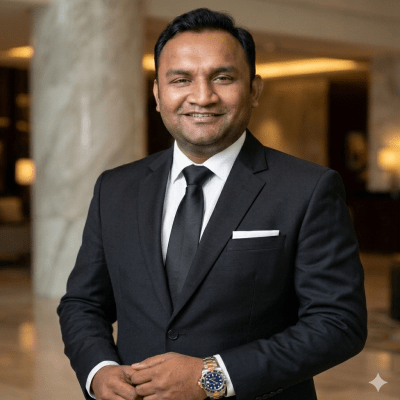
Nikunjj Jhawar is a Chartered Accountant (CA) and Chartered Financial Analyst (CFA) with nearly two decades of experience in the financial services industry. Having worked with global institutions such as HSBC and Credit Suisse in investment-related roles, he brings deep expertise in finance and markets. He is the Founder of mangopeoplenews.com, where he focuses on making complex topics in finance, markets and business accessible and relevant to everyday readers.

