Zee’s FIFA World Cup Bet Is About Far More Than Football. It’s A High-Stakes Attempt To Rebuild The Company’s Future.
For years, Zee Entertainment Enterprises was viewed as one of India’s most influential media empires. Then came the difficult years. The collapse of the Sony merger, intensifying competition from streaming giants, slowing television advertising growth, governance scrutiny and the rise of the Reliance-Disney media combine fundamentally altered Zee’s position in India’s entertainment hierarchy.
Now, the company is attempting a comeback through an unexpected route: Football.
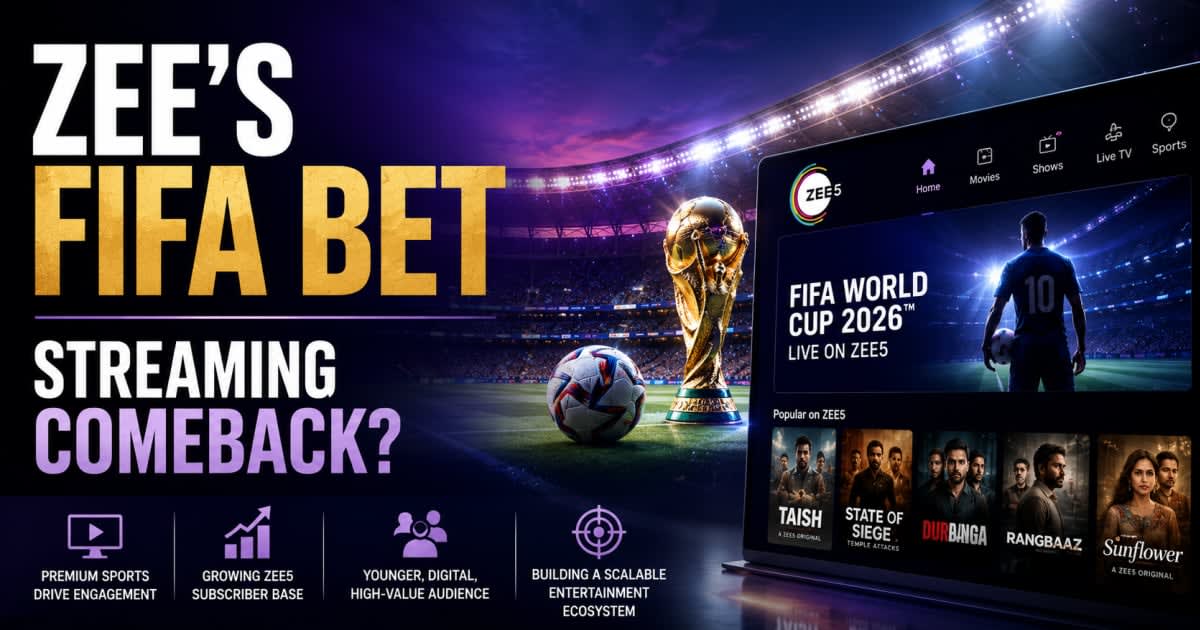
Zee’s aggressive move to secure FIFA World Cup rights through 2034 — including the 2026 and 2030 World Cups — is not merely a sports broadcasting deal. It is a strategic reset designed to revive subscriber growth, strengthen ZEE5, rebuild advertiser confidence and reposition Zee as a serious digital media player again.
The real question is whether football can do for Zee what cricket once did for India’s biggest media networks: create an ecosystem powerful enough to drive both scale and profitability simultaneously.
This Is Not Really About Sports. It’s About Survival In The Streaming Era.
India’s entertainment industry has changed dramatically over the last five years.
Television advertising growth has slowed.
Digital streaming economics remain brutal.
Global platforms have intensified competition.
And premium sports rights increasingly determine which platforms consumers actually pay for.
That last point matters enormously.
In the streaming era, content alone is rarely enough to build sticky subscriptions. Live sports remains one of the few categories capable of driving:
- habitual engagement,
- premium advertising,
- appointment viewing,
- and direct paid subscriptions.
That explains why companies globally spend billions chasing sports rights despite uncertain near-term returns.
Zee understands this reality.
Its FIFA World Cup acquisition is effectively an attempt to create a high-value consumer funnel into:
- ZEE5 subscriptions,
- sports advertising,
- digital engagement,
- and broader platform monetisation.
Industry reports suggest Zee is even avoiding aggressive telecom bundling initially because it wants viewers to subscribe directly to ZEE5 rather than consuming the event passively through bundled distribution.
That signals a very specific strategic shift:
Zee wants subscriber ownership, not merely audience reach.
Why FIFA Matters More Than The Tournament Itself
At first glance, football may appear like an unusual bet for an Indian broadcaster competing in a cricket-dominated country. But Zee may actually be targeting a very different demographic. Football audiences in India tend to skew:
- younger,
- urban,
- digitally active,
- premium-advertiser friendly,
- and subscription-oriented.
That audience profile is extremely valuable for OTT platforms. Unlike mass television entertainment, premium sports audiences often overlap with:
- smartphone-first consumers,
- higher spending households,
- and digitally engaged viewers.
The World Cup also gives Zee something it lacked for years: event-driven urgency. Streaming platforms struggle when content consumption becomes passive and fragmented. Global sports tournaments temporarily reverse that trend by creating national-scale live engagement.
And engagement drives monetisation.
Zee Is Quietly Rebuilding Its Sports Ambitions
Many investors forget that Zee once had serious sports broadcasting ambitions before exiting the space years ago.
The FIFA rights acquisition suggests the company is attempting a re-entry — but this time through a digital-first strategy rather than traditional television dominance alone. The company is already launching:
- Unite8 Sports channels,
- FIFA-linked programming,
- digital integrations,
- and broader sports distribution infrastructure.
This matters because owning sports rights is not enough anymore. Modern sports monetisation increasingly depends on:
- streaming ecosystems,
- advertising technology,
- multilingual engagement,
- social amplification,
- subscription retention,
- and data-led audience monetisation.
The FIFA deal potentially gives Zee a multi-year platform to rebuild those capabilities.
The Company Needs Growth Drivers Urgently
Zee’s financial performance over recent years reflects the broader pressure facing legacy broadcasters. Advertising volatility, rising content costs and digital competition have weighed on profitability. Reuters recently reported that Zee slipped into quarterly losses amid weaker advertising demand and higher spending, although ZEE5 showed strong subscription-led improvement and narrowing losses.
That detail is extremely important.
The core television business may be maturing.
But ZEE5 is still in expansion mode. And increasingly, Zee’s long-term valuation may depend less on linear TV and more on whether it can build a scalable digital ecosystem capable of competing against:
- JioStar,
- Netflix,
- Amazon Prime Video,
- Sony LIV,
- and YouTube-led consumption patterns.
The FIFA rights therefore are not just content acquisition. They are customer acquisition infrastructure.
Investors Are Starting To Reprice The Story
Markets appear to be recognising the strategic significance of the FIFA deal.
Zee’s stock rallied sharply after the announcement, while the company simultaneously approved plans to raise at least ₹2,300 crore for future strategic initiatives and balance-sheet strengthening.
The timing is unlikely to be accidental.
Sports rights require capital.
Digital expansion requires capital.
Content ecosystems require capital.
Zee appears to be preparing for a longer competitive battle rather than a short-term ratings play.
But The Risks Are Very Real
The optimism around FIFA should not hide the structural challenges ahead. Sports broadcasting is notoriously expensive. Subscriber conversion is uncertain. And monetisation becomes harder when matches air in unfavourable Indian time zones due to North American scheduling.
There is also the larger competitive threat.
JioStar now controls an extraordinary share of India’s premium sports ecosystem across:
- IPL,
- ICC events,
- Premier League,
- and other marquee properties.
Competing against that scale will not be easy. The FIFA World Cup may generate attention.
Whether it creates sustained subscriber behaviour is a much harder question.
The Bigger Battle Is About Relevance
At its peak, Zee shaped Indian television culture itself. Today, the company is fighting a different battle: remaining strategically relevant in an entertainment industry increasingly dominated by platform ecosystems rather than standalone channels. That is why the FIFA move matters so much. It signals that Zee no longer wants to compete merely as a legacy broadcaster. It wants to reposition itself as:
- a digital entertainment platform,
- a subscription ecosystem,
- and eventually a sports-plus-entertainment hybrid media company.
That transformation is extremely difficult.
But without attempting it, the company risks gradual decline inside a rapidly consolidating media market.
The Verdict
Zee’s FIFA World Cup gamble is not really a sports story. It is a turnaround story. The company is betting that premium global sports can help accelerate:
- ZEE5 adoption,
- advertiser interest,
- digital monetisation,
- and long-term platform relevance.
If the strategy works, FIFA could become the beginning of Zee’s second act in India’s media industry. If it fails, the company may discover that in the streaming era, buying premium content is far easier than building a profitable digital ecosystem around it.
Either way, the next few years may determine whether Zee remains a legacy broadcaster adapting slowly to change — or successfully reinvents itself for the platform economy altogether.

Nikunjj Jhawar is a Chartered Accountant (CA) and Chartered Financial Analyst (CFA) with nearly two decades of experience in the financial services industry. Having worked with global institutions such as HSBC and Credit Suisse in investment-related roles, he brings deep expertise in finance and markets. He is the Founder of mangopeoplenews.com, where he focuses on making complex topics in finance, markets and business accessible and relevant to everyday readers.