

REC-PFC Merger Talk Isn’t Just About Consolidation. It’s About Who Will Finance India’s Energy Transition.
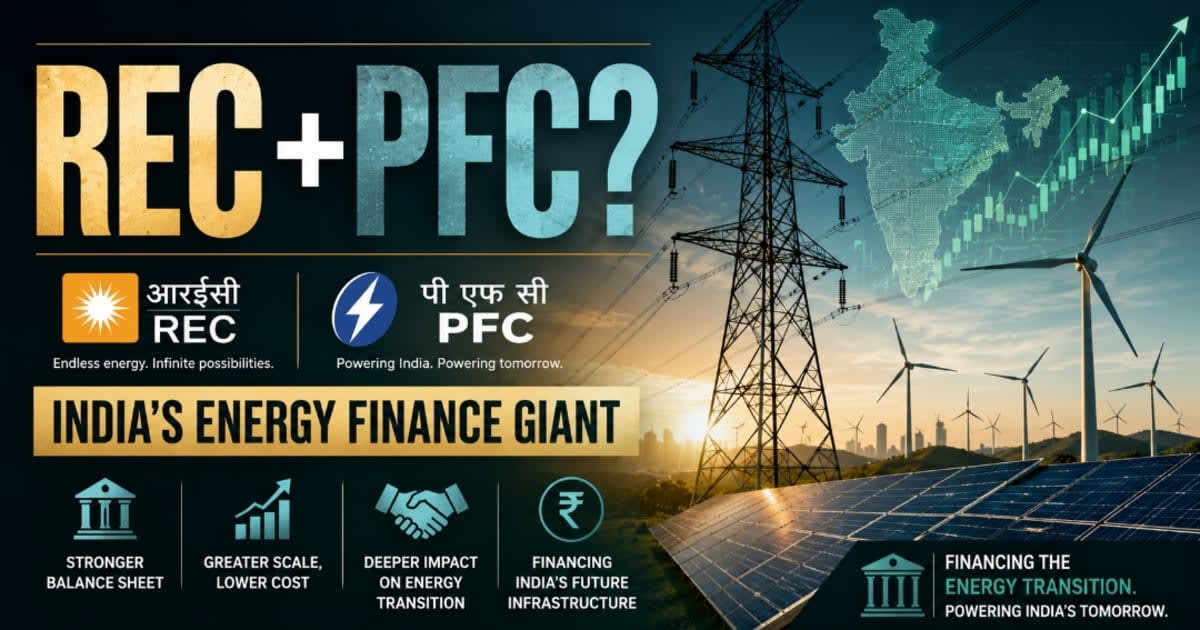
Every few months, the possibility of a merger between REC Limited and Power Finance Corporation returns to the market conversation.
And every time it does, investors ask the same question: Would combining two of India’s biggest power financiers actually create a stronger institution — or simply a larger bureaucracy?
At first glance, the logic appears obvious.
Both companies operate in nearly identical sectors. Both are government-backed lending giants. Both finance India’s power ecosystem. And both increasingly sit at the centre of one of the largest infrastructure transformations India has attempted in decades: the energy transition.
But beneath the surface, the merger debate is less about overlap and more about scale, strategy and control over India’s future infrastructure financing architecture.
Because the real story here is not power lending anymore. It is nation-scale capital allocation.
Two Giants Built For India’s Electrification Era
For decades, REC and PFC played a similar role: funding India’s power backbone. They financed:
thermal plants,
transmission infrastructure,
distribution companies,
rural electrification,
hydro projects,
and state electricity ecosystems.
In many ways, both institutions were products of an earlier India — one focused primarily on solving electricity shortages and expanding grid access. That mission largely succeeded.
India today is no longer merely trying to electrify villages. It is attempting something far more ambitious: building one of the world’s largest renewable energy and power infrastructure ecosystems simultaneously. And that transition requires enormous financing capacity.
The Real Opportunity Is No Longer Coal. It’s Energy Transition Financing.
India’s renewable energy ambitions are staggering. The country is targeting massive expansion across:
solar,
wind,
battery storage,
green hydrogen,
transmission corridors,
smart grids,
EV-linked infrastructure,
and industrial decarbonisation.
This transition could require trillions of rupees in financing over the next decade. That changes the strategic importance of REC and PFC entirely.
They are no longer just PSU lenders supporting electricity boards. They are gradually becoming critical institutions financing India’s broader energy transformation. And that is where merger discussions begin making strategic sense.
Why The Government May Eventually Want A Larger Unified Institution
Globally, infrastructure transitions are often financed through large specialised institutions capable of:
raising low-cost capital,
absorbing long-duration risks,
and lending at enormous scale.
China used state-backed financial institutions aggressively during its infrastructure expansion. Western economies rely heavily on development banks and sovereign-backed financing structures.
India’s government may eventually conclude that maintaining two large overlapping PSU financiers is inefficient when the next phase of energy financing requires scale consolidation.
A merged REC-PFC entity could potentially become one of India’s largest infrastructure lenders, a dominant energy-transition financier and a globally relevant power-financing institution.
That scale matters because renewable transitions are capital-intensive and long-duration by nature.
But Bigger Institutions Don’t Automatically Become Better Institutions
This is where the merger debate becomes more complicated. Both REC and PFC may look similar externally, but investors understand that they operate with distinct:
lending cultures,
portfolio mixes,
risk profiles,
and management approaches.
PFC historically maintained stronger exposure to larger power-sector financing and broader infrastructure lending. REC built deeper positioning around rural electrification and state-linked financing ecosystems. Merging large financial institutions is rarely simple. Balance-sheet integration, cultural alignment, operational overlap and portfolio harmonisation often become far more difficult than policymakers initially expect.
India’s banking history itself offers multiple examples where mergers created temporary efficiency gains, but also operational complexity and slower execution.
Investors Are Divided For A Reason
The market’s reaction to merger speculation is often mixed because the implications are genuinely complex. On one side, investors see clear positives stronger balance-sheet scale, improved capital-raising capability, operational synergies, lower duplication and stronger strategic positioning. A combined institution could potentially negotiate cheaper borrowing costs globally because of size and sovereign perception advantages.
But sceptics worry about something equally important: loss of competition. Today, REC and PFC effectively compete within the same ecosystem while also co-financing projects. That dynamic creates internal market discipline. A merger could reduce competitive efficiency while increasing bureaucratic centralisation.
And in infrastructure lending, execution quality matters more than sheer scale.
The Dividend Machine Investors Don’t Want Disturbed
There is another reason investors closely watch merger speculation: both companies became favourites among dividend-focused PSU investors. REC and PFC have historically offered:
high dividend yields,
strong cash generation,
relatively stable loan books,
and predictable government-linked business visibility.
For many retail and institutional investors, these companies are not merely energy-transition plays. They are income-generating PSU cash-flow stories. Any merger raises inevitable questions around dividend policy, valuation alignment, share-swap ratios and capital allocation priorities.
Those concerns partly explain why merger rumours often trigger sharp market reactions. The Bigger Risk Sits Inside India’s Power Sector Itself Even without a merger, both institutions face a structural challenge: India’s power sector remains financially uneven. State distribution companies continue struggling with losses, delayed payments, political tariff pressures and operational inefficiencies.
While renewable growth is accelerating, the financial health of parts of the broader electricity ecosystem remains fragile.
That means REC and PFC simultaneously sit at the intersection of India’s biggest infrastructure opportunity and one of its most structurally difficult financing sectors. Managing that balance will define their future far more than merger headlines alone.
The Energy Transition Could Redefine Both Companies
Historically, these lenders were viewed largely as PSU financing vehicles. That perception may change dramatically over the next decade.
If India successfully executes its renewable ambitions, REC and PFC could evolve into something much larger: core financing engines of India’s industrial and energy transformation. Their future loan books may increasingly include:
battery ecosystems,
grid modernisation,
data-centre power infrastructure,
green hydrogen projects,
transmission corridors,
and climate-linked industrial financing.
In other words, the market may eventually stop valuing them merely as PSU NBFCs and start viewing them as strategic energy-transition institutions. That distinction matters enormously for long-term valuations.
The Verdict: The Merger Debate Is Really About India’s Next Infrastructure Era
The REC-PFC merger discussion is not simply about combining two government lenders. It reflects a much bigger question: how India wants to finance its next generation of infrastructure growth. The country is entering an era where:
electrification,
decarbonisation,
manufacturing,
EV adoption,
and digital infrastructure
will require financing at unprecedented scale. Whether REC and PFC remain separate or eventually combine, one reality is becoming increasingly clear: their strategic importance to India’s economic future is likely to rise, not fall.
Because the institutions controlling capital flow into energy infrastructure may ultimately become just as important as the companies generating the power itself.
And in India’s next growth cycle, financing the transition may prove as valuable as building it.

Nikunjj Jhawar is a Chartered Accountant (CA) and Chartered Financial Analyst (CFA) with nearly two decades of experience in the financial services industry. Having worked with global institutions such as HSBC and Credit Suisse in investment-related roles, he brings deep expertise in finance and markets. He is the Founder of mangopeoplenews.com, where he focuses on making complex topics in finance, markets and business accessible and relevant to everyday readers.
