

Rapido Wants To Reinvent Food Delivery: Can Its Low-Cost Model Challenge Zomato And Swiggy?
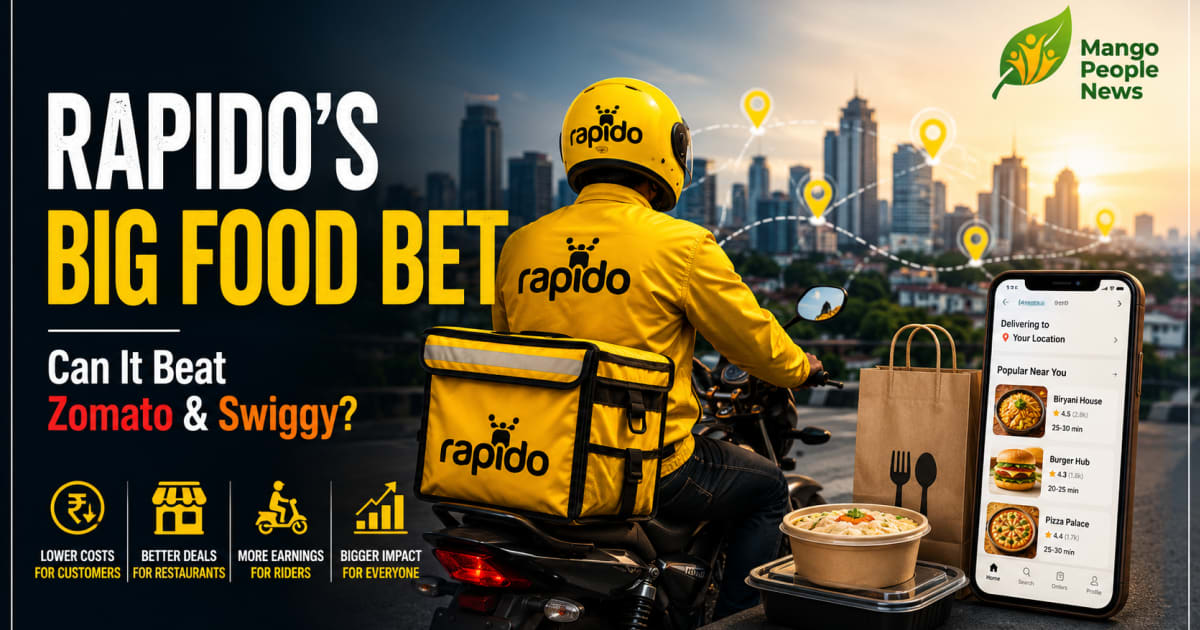
India's online food delivery industry has been dominated by two names for almost a decade—Zomato and Swiggy. Together, the two companies have transformed how millions of Indians order meals, built one of the country's largest hyperlocal logistics networks and created a market worth billions of dollars.
Yet despite their scale, the industry continues to face a familiar problem. Restaurants complain about high commissions, customers are increasingly frustrated by delivery fees and platform charges, while delivery partners continue demanding better earnings. In other words, every stakeholder believes the current system could work better.
Now, ride-hailing company Rapido wants to challenge the industry's very foundation.
Instead of competing through deep discounts or expensive marketing campaigns, the Bengaluru-based startup believes the economics of food delivery itself needs to change. Its vision is simple: build one large logistics network that moves everything—from passengers and parcels to groceries and restaurant meals—and use that shared infrastructure to reduce delivery costs. Rapido's leadership argues that unless online food delivery expands to 100 million users, the industry will never realise its full potential.
The company's strategy is therefore not merely about launching another food delivery app. It is an attempt to build a lower-cost logistics platform that could expand the overall market rather than simply take customers away from existing players.
Why Rapido Believes The Current Model Needs A Reset
Rapido Co-founder and CEO Aravind Sanka believes India's online food delivery market remains significantly underpenetrated despite years of rapid growth.
The reasoning is straightforward.
India has hundreds of millions of smartphone users and one of the world's youngest digital populations. Yet only a fraction of consumers order food online regularly. According to Rapido, the primary reason is affordability rather than lack of demand.
Over the years, food delivery has become more expensive as customers pay delivery charges, platform fees, packaging costs and, in many cases, higher menu prices than restaurants charge offline.
Rapido believes the next phase of growth will not come from offering bigger discounts but from permanently lowering the cost of delivery through better logistics and higher operational efficiency.
One Network, Multiple Businesses
Unlike a traditional food delivery startup, Rapido isn't building its logistics network from scratch.
The company already operates one of India's fastest-growing mobility platforms, offering Bike taxis, Auto-rickshaw rides, Cab services, Parcel delivery and Hyperlocal logistics.
This existing network gives Rapido a structural advantage. Instead of maintaining separate fleets for different services, the same rider ecosystem can potentially serve multiple categories depending on demand. For example, a rider may transport office commuters during the morning rush, deliver parcels during the afternoon and handle restaurant orders during lunch and dinner hours.
Higher rider utilisation improves earnings for delivery partners while reducing the average logistics cost per order. This shared-network philosophy sits at the heart of Rapido's expansion strategy.
The Company Is Already Challenging Established Players
Rapido's rapid expansion has already disrupted India's ride-hailing industry. The company has built a large monthly active user base and has emerged as one of Uber's strongest competitors in India, while also putting pressure on Ola through its focus on affordable two-wheelers, auto-rickshaws and a flat-fee driver model instead of traditional commission-based pricing.
That experience provides management with confidence that a similar disruption is possible in food delivery. The company's philosophy remains consistent across businesses—reduce costs, improve affordability and increase market penetration instead of competing only for premium users.
Affordability Could Unlock The Next 70 Million Customers
Rapido argues that India's online food delivery market has largely catered to urban consumers willing to pay a premium for convenience.
Its next phase of growth could come from millions of customers who currently avoid ordering online because the final bill becomes significantly higher than eating at the restaurant or ordering directly.
By lowering logistics costs rather than relying on promotional discounts, Rapido believes food delivery can become an everyday service instead of an occasional convenience. If successful, this approach could benefit every participant in the ecosystem:
Customers pay less.
Restaurants retain a larger share of every order.
Delivery partners receive more consistent work.
Platforms improve long-term operational efficiency.
Instead of fighting over the same customers, Rapido is attempting to bring entirely new users into the market.
How Rapido Compares With Zomato And Swiggy
While Rapido's ambitions are significant, it enters a market led by two deeply entrenched players.
Zomato has evolved into a broader consumer technology company through food delivery, quick commerce via Blinkit and restaurant services.
Swiggy has expanded beyond restaurants into quick commerce, logistics and merchant solutions.
Both companies possess extensive restaurant relationships, sophisticated delivery technology and strong consumer brands.
Rapido's differentiator is not restaurant discovery or app design—it is logistics economics. The company believes a shared mobility network can deliver orders at a lower cost than platforms dedicated primarily to food delivery.
Whether that advantage proves sustainable will depend on execution.
ONDC Could Strengthen Rapido's Strategy
Another important factor is the growth of the Open Network for Digital Commerce (ONDC).
Unlike closed marketplaces where one platform controls the customer relationship, ONDC allows different participants to connect through a common digital network.
For logistics companies like Rapido, this could reduce customer acquisition costs, simplify merchant onboarding and create additional delivery opportunities beyond their own applications.
As ONDC expands, companies with efficient logistics capabilities may gain new avenues for growth without relying solely on proprietary ecosystems.
Challenges Remain Significant
Rapido's strategy is ambitious, but success is far from guaranteed. The company must simultaneously:
Build restaurant partnerships.
Maintain delivery quality.
Attract and retain riders.
Keep customer acquisition costs under control.
Deliver consistently lower prices.
Compete with two well-funded incumbents.
In addition, regulatory uncertainty surrounding bike taxis in several states remains a challenge for its broader mobility business. The company's ability to execute efficiently across multiple businesses will determine whether its integrated logistics model becomes a genuine competitive advantage.
The Bottom Line
Rapido's move into food delivery represents more than another startup entering an already crowded market. The company is questioning the economics on which India's food delivery industry has been built.
Rather than competing through discounts or advertising, it wants to reduce the cost of logistics by leveraging a single network across mobility, parcel delivery and food delivery.
If this model succeeds, Rapido may not simply challenge Zomato and Swiggy—it could expand the overall food delivery market by making online ordering affordable for millions of new consumers.
The next phase of India's food delivery battle is therefore unlikely to be decided by who spends the most on customer acquisition. It may instead be won by the company that builds the most efficient logistics network.

Nikunjj Jhawar is a Chartered Accountant (CA) and Chartered Financial Analyst (CFA) with nearly two decades of experience in the financial services industry. Having worked with global institutions such as HSBC and Credit Suisse in investment-related roles, he brings deep expertise in finance and markets. He is the Founder of mangopeoplenews.com, where he focuses on making complex topics in finance, markets and business accessible and relevant to everyday readers.


