

At 70, LIC Is Quietly Becoming a Different Kind of Giant: Insurance Is Just the Beginning of What India's Largest Financial Institution Is Building
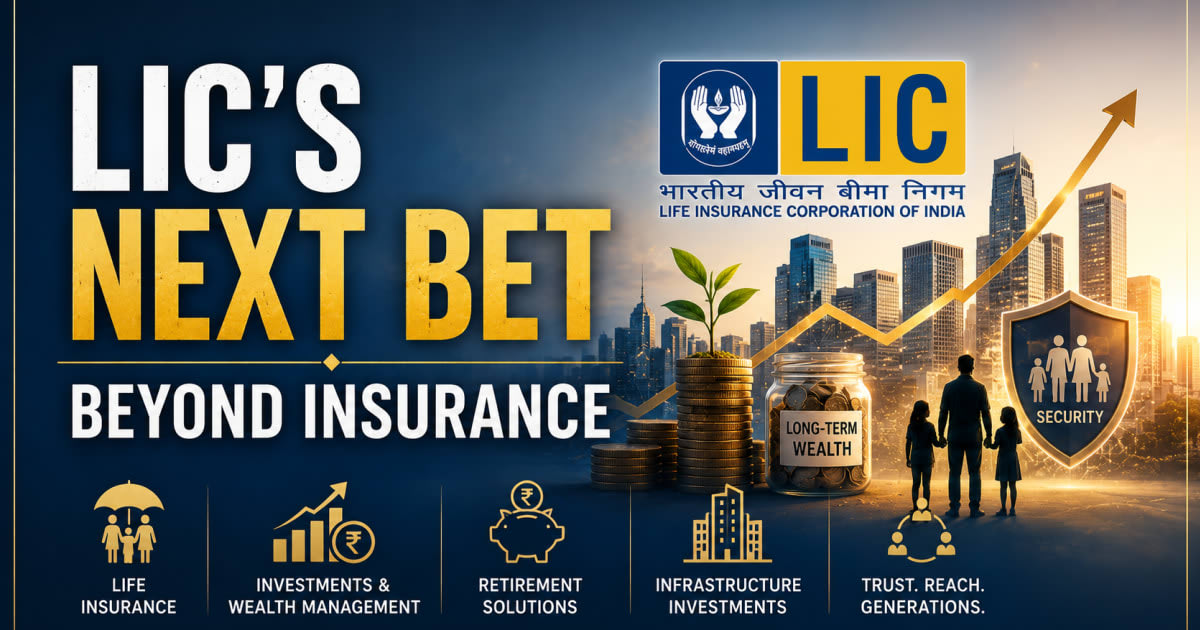
On September 1, 1956, the Indian government nationalised 245 private insurance companies and merged them into a single entity with ₹5 crore in initial capital and a mandate to spread life insurance to every corner of the country. Seven decades later, that entity manages assets worth over ₹57 lakh crore — more than the combined assets of most of India's commercial banks — controls nearly 60% of the life insurance market, owns real estate valued at approximately ₹60,000 crore, holds stakes in IDBI Bank and dozens of other financial institutions, and is on the verge of its platinum jubilee with a CEO who is making it clear that the next chapter will look very different from the last seven decades.
"Our aspiration for the 75th year, the 100th year and beyond is to see LIC thriving, flourishing and contributing to national development," MD and CEO R. Doraiswamy said this week. The statement sounds ceremonial. The strategic moves happening behind it are anything but.
THE FINANCIAL POSITION: WHAT THE NUMBERS ACTUALLY SAY
Before examining where LIC is going, it helps to understand just how large the institution already is.
LIC manages assets worth over ₹57 lakh crore, operates 2,048 fully computerised branch offices, has a presence in 13 countries through branch offices, joint ventures, and wholly-owned subsidiaries, and controls approximately 60% market share in India's life insurance segment. Its equity investment portfolio alone has driven hundreds of points of Sensex movement over the years — when LIC buys or sells, markets notice.
For FY25, LIC reported net profit of ₹41,289 crore and total premium income growing significantly year-on-year. The corporation has been consistently profitable since its listing on the BSE and NSE in May 2022 — one of the most significant public offerings in Indian financial history.
Individual first-year premiums are targeted at over ₹35,000 crore for the current fiscal — up from ₹31,000 crore achieved in the prior year. Pension and group security businesses have grown at over 27% annually. Total policy payments have crossed ₹1.12 lakh crore. Under social security schemes, LIC has insured 5.81 crore lives — a social mandate that no private insurer comes close to matching.
The stock — listed at ₹949 — has broadly tracked the Nifty 50, with the market still in the process of price-discovering an institution this large and this structurally unusual. At a market capitalisation of approximately ₹6.10 lakh crore, LIC is among the five most valuable listed companies in India — trading at approximately 2.5x FY25 book value and roughly 15x earnings, broadly in line with comparable financial conglomerates globally.
THE INSURANCE BUSINESS: DEFENDING A 60% LEAD IN A MARKET GETTING CROWDED
India's life insurance penetration stands at approximately 3.2% of GDP — well below the global average of 7% and significantly below developed markets. The runway for growth is extraordinary. But that runway is increasingly being pursued by well-capitalised private players.
HDFC Life, SBI Life, ICICI Prudential, and Max Life have collectively taken meaningful market share from LIC over the past decade. LIC's market share in new business premium has declined from over 70% a decade ago to approximately 58–60% today. The private players have been outpacing LIC in urban, affluent segments, unit-linked products, and protection plans — the higher-margin categories that determine long-term profitability.
Doraiswamy's response to this competitive reality was direct: "As more players enter the market, our objective is not only to retain leadership but to maintain a substantial lead."
The mechanism for doing that involves several simultaneous moves. LIC has recently launched Jeevan Anand — a combination endowment and whole-life plan — and relaunched individual pension plans including New Jeevan Akshay, New Jeevan Dhara, and Jeevan Suraksha, giving it competitive products across multiple customer segments. The corporation added more than 44,000 new agents in the current fiscal, keeping its 1.3 million-strong agent network — the largest insurance distribution force in the world — not just intact but growing.
The focus on term and protection products — historically undersold through LIC's agent network relative to private competitors — is the most strategically important shift. Protection products carry significantly better margins than traditional savings-cum-insurance endowment plans, and expanding this mix is the single most efficient path to profitability improvement.
THE NEXT BIG BET: A FINTECH ARM
Here is the development that most observers have not fully processed yet — and the one most likely to reshape how the market values LIC over the next decade.
LIC is actively considering establishing a fintech arm — either through strategic investment or organically — to cater to its growing digital needs. Doraiswamy said: "Naturally, to meet the modernisation requirement and particularly to bring innovation, we are engaging both fintech and insurtech players, and we are getting a lot of new things being developed by such players."
He added: "We are a big financial institution investing in multiple organisations, and we also look at strategic investments in any specialised player as a way of improving the returns on the policyholders' funds."
The practical implications of a LIC fintech arm are significant and underappreciated. LIC currently has relationships with approximately 30 crore policyholders — more than any bank, any payment app, or any fintech platform in India. It has their income data, their family composition, their risk appetite, and their long-term financial behaviour. What it has historically lacked is the technology infrastructure to leverage that data into cross-sell, personalised pricing, and digital services.
A fintech arm — whether built or bought — would give LIC the capability to turn that 30-crore policyholder relationship into a financial services platform. The equivalent in the private sector is what Bajaj Finance did with its EMI card network or what Reliance Jio did with its 400 million subscribers. When a company with this kind of customer penetration builds a genuine fintech infrastructure, the cross-sell potential is enormous.
THE MUTUAL FUND AMBITION
LIC Mutual Fund — the asset management subsidiary — is targeting ₹1 lakh crore AUM by the end of 2026 and aims to reach the top 10 fund houses in India within five years. That would represent approximately 4x growth from its current size.
The AMC, led by MD and CEO Ravi Kumar Jha, is banking on LIC's unparalleled distribution reach — particularly in Tier-2 and Tier-3 cities and among rural customers who have never invested in mutual funds — to drive customer acquisitions that urban-focused private AMCs cannot match as efficiently.
LIC's agent network is the distribution asset that makes this credible. A trained LIC agent already has the customer relationship and the insurance underwriting conversation as the context. Adding mutual fund recommendations to that conversation is a natural extension — and one that private mutual fund distributors have to spend significant money to replicate. If LIC's AMC can leverage even 10% of the policyholder base into mutual fund customers, the AUM trajectory changes dramatically.
THE IDBI BANK STAKE: THE STRATEGIC ASSET NOBODY FULLY VALUES
Among LIC's six associates, IDBI Bank deserves particular attention. LIC holds approximately 49.24% of IDBI Bank — making it the largest shareholder, ahead of the government's 45.48% stake.
The government's plan to divest its IDBI Bank stake has been discussed, deferred, and discussed again. If and when that divestment happens, LIC's stake in IDBI Bank becomes a pivotal variable — both as a potential buyer of additional shares and as a holder of a large position that would be repriced by any change in the ownership structure.
IDBI Bank's transformation from a stressed lender to a profitable private-sector-style bank is well underway. If the bank achieves a valuation re-rating comparable to private sector peers over the next three years, LIC's stake alone could represent ₹1.5–2 lakh crore of embedded value — not yet reflected in LIC's market capitalisation in any meaningful way.
THE PENSION PLAY: INDIA'S MOST UNDERPENETRATED FINANCIAL PRODUCT
India has a pension problem. A working population of over 500 million people, of whom the vast majority have no formal retirement savings beyond whatever they have accumulated informally. The National Pension System has made progress — crossing ₹16 lakh crore in AUM — but pension penetration as a percentage of the working population remains among the lowest in the world for a G20 economy.
LIC's product suite already includes annuity and pension products. The group's relaunching of individual pension plans and the PFRDA's recent approval of LIC AMC as a pension fund sponsor under NPS creates the foundation for LIC to become a dominant player in India's retirement savings market — a category that, with the right regulatory framework, could grow to ₹50–100 lakh crore in AUM within two decades.
The competitive advantage LIC brings to pension distribution is not its brand or its scale alone — it is the 1.3 million agents who already have the trust-based customer relationships required to sell long-term, deferred savings products. Pension selling requires the same patient, relationship-driven approach that LIC's insurance model is built on. Private fintech platforms are poorly positioned to replicate that in the short term.
THE TECHNOLOGY TRANSFORMATION
LIC's digital journey has historically lagged private sector competitors. The insurer has tied up with some banks and service providers to offer online premium collection facilities, and has digitised its branch network to 2,048 fully computerised offices. But the user experience for policyholders interacting with LIC digitally has been significantly behind what private insurers offer.
The fintech arm initiative is partly motivated by the recognition that this gap is sustainable only for so long. LIC's policyholder base is multigenerational — it includes customers in their 70s who prefer agent-mediated relationships and customers in their 20s who expect app-first experiences. Serving both simultaneously requires a technology platform that LIC's legacy systems were not designed to provide.
The engagement with fintech and insurtech players — and the stated willingness to make strategic investments in specialised technology companies — signals that LIC has recognised the problem and is prepared to invest to solve it. Whether that investment happens through acquisition, joint venture, or organic build will be watched closely by both technology companies and investors.
WHAT TO WATCH IN THE YEAR AHEAD
IDBI Bank divestment timeline. Any concrete movement on the government's IDBI Bank stake sale will trigger a re-evaluation of LIC's balance sheet and strategic options. Watch for cabinet committee decisions and regulatory approvals that signal the divestment is moving from discussion to execution.
Fintech arm announcement. The MD has stated the intent publicly. Watch for a formal announcement — either of a strategic investment in an existing fintech or the filing of a new subsidiary — that puts structure around what has so far been a stated ambition.
LIC Mutual Fund AUM milestone. The ₹1 lakh crore AUM target is concrete and time-bound. Watch quarterly AUM disclosures from AMFI — any quarter where LIC MF's growth rate accelerates meaningfully above the industry average suggests the distribution leverage is beginning to work.
New business premium growth. The ₹35,000 crore individual new business target represents meaningful growth from the prior year. Whether this is achieved — and whether the product mix shifts toward higher-margin protection and term products — will determine the quality of the growth, not just its quantity.
Market share trajectory. LIC's market share in new business premium has been declining slowly for a decade. Any reversal of that trend — or even a stabilisation — would be a significant positive signal. Watch the quarterly IRDAI market share data.
THE PLATINUM JUBILEE CONTEXT
On September 1, 1956, LIC was created with five crore rupees and a mandate to serve the nation. On September 1, 2026, it will mark 70 years with ₹57 lakh crore in assets and the most ambitious strategic agenda it has set in decades.
"As the economy grows, LIC grows. LIC's growth, in turn, supports the economy. It has always been a mutually reinforcing relationship," Doraiswamy said. That statement contains more strategic insight than it might initially appear to. LIC is not merely a passive beneficiary of India's economic growth. It is one of its architects — channelling policyholder savings into infrastructure bonds, government securities, and equity markets at a scale that shapes the economy it depends on.
The question for the next decade is not whether LIC will survive the competition from private players — 60% market share and ₹57 lakh crore in assets are not easily eroded. The question is whether LIC can reinvent itself — from a pure insurance institution to a diversified financial conglomerate with a genuine technology platform, a growing mutual fund business, a pension leadership position, and a fintech arm that leverages its 30 crore customer relationships in ways the insurance product alone never could.
If it does, the market's current valuation of LIC as an insurance company will look, in hindsight, like a significant underestimate of what it actually is. The platinum jubilee is not just a celebration. It is an inflection point.

Nikunjj Jhawar is a Chartered Accountant (CA) and Chartered Financial Analyst (CFA) with nearly two decades of experience in the financial services industry. Having worked with global institutions such as HSBC and Credit Suisse in investment-related roles, he brings deep expertise in finance and markets. He is the Founder of mangopeoplenews.com, where he focuses on making complex topics in finance, markets and business accessible and relevant to everyday readers.


