

Airtel's Quiet Transformation: From India's Second-Largest Telco to a Global Digital Conglomerate With Africa, AI, Indus Towers — and ₹2L CR Revenue

Sunil Bharti Mittal has been doing this for four decades. He started by assembling bicycle parts, pivoted to push-button telephones, and somehow ended up building the third-largest mobile network in the world. Through every cycle — liberalisation, the dot-com bust, the Jio disruption, the pandemic — Airtel has adapted, consolidated, and come out the other side bigger and more complex than when it went in.
FY26 was another one of those years. The announcements that landed on May 13 — Q4 results, a landmark Africa deal, a leadership reappointment, and a ₹24 dividend — paint the clearest picture yet of what Airtel is actually becoming. Not just a telecom company. Something considerably more interesting than that.
THE RESULTS: RECORD REVENUES, A CONFUSING HEADLINE, AND WHY THE MARKET GOT IT RIGHT
Consolidated revenues for FY26 grew 22% year-on-year to ₹2,10,973 crore — Airtel's first year crossing ₹2 lakh crore in annual revenue. Full-year net profit increased 53.1% to ₹26,904 crore.
The Q4 headline — a 22% year-on-year profit decline to ₹7,325 crore — is deliberately misleading without context. Last year's Q4 included a one-time deferred tax credit of approximately ₹5,600 crore. Strip that out and pre-tax profit surged 36% year-on-year. The quarterly profit also grew 10.5% sequentially — the business accelerated, not decelerated.
Consolidated EBITDA reached ₹32,038 crore with a 57.8% margin — a 16.9% year-on-year improvement. Capex stood at ₹16,066 crore, focused on 5G densification, fibre, and data centres. Over FY26, the company rolled out 43,290 kilometres of new fibre and added 7,883 towers. (Wikipedia) A final dividend of ₹24 per share was declared — the highest in the company's history.
ARPU AND INDIA: THE MONETISATION MACHINE
If there is one metric that explains Airtel's financial trajectory better than any other, it is ARPU. ARPU climbed to ₹257 in Q4 FY26 from ₹245 a year earlier. Smartphone data customers grew 20 million year-on-year, contributing 80% of all mobile customers. The homes broadband business grew 37.3% YoY, adding 1.135 million customers in the quarter, taking the total base to 14.2 million.
Every ₹10 of ARPU improvement flows almost entirely to profitability. Analysts expect Airtel to benefit significantly from the next industry-wide tariff hike — now that 5G capex has peaked, incremental revenue flows more directly to free cash flow than at any point in the past four years.
Gopal Vittal summarised the landmark quarter: "We crossed the 650 million customer mark, launched our telco grade sovereign cloud, received RBI approval through our subsidiary to commence the lending business, and accelerated the expansion of our data centre footprint."
Three of those four announcements — sovereign cloud, lending, data centres — are not telecom products. They are the building blocks of a diversified digital conglomerate being assembled quietly, quarter by quarter.
THE AFRICA DEAL: CONSOLIDATING BEFORE THE MONEY IPO
The announcement that overshadowed even the results was the ₹28,222 crore share swap deal to deepen Airtel's control over its African operations. Airtel's board approved the issuance of up to 146.76 million equity shares to promoter entity ICIL, in exchange for a 16.31% stake in Airtel Africa. Post-transaction, Airtel's holding rises from 62.73% to approximately 79.04%.
Three things make this deal structurally compelling. First, it is cashless and leverage-neutral — the company confirmed it does not involve any cash outflow or additional debt. Second, it is EPS accretive — Airtel Africa shares are acquired at an 11.6% discount to market, while Airtel India shares are issued at a 9.5% premium. Third, the timing is deliberate. Airtel Money's IPO — deferred to H2 2026 amid market volatility — will be one of the most watched African fintech listings of the year. By owning 79% before that listing, Airtel India captures the maximum value when public markets price that mobile money business. Africa's mobile money ecosystem is accelerating rapidly — serving hundreds of millions of people across 14 countries where traditional banking infrastructure remains underdeveloped. This is not a bet on a quarter. It is a bet on a continent over a decade.
INDUS TOWERS: THE SUBSIDIARY THAT'S QUIETLY GOING GLOBAL
Indus Towers — India's second-largest telecom infrastructure provider, a key subsidiary of Bharti Airtel with over 251,773 towers across 22 telecom circles — announced its foray into African markets, beginning with Nigeria, Uganda, and Zambia. By January 2026, Indus had already incorporated two new step-down subsidiaries — Indus Towers Nigeria Limited and Indus Towers Infra Zambia Limited — formally establishing boots on the ground.
The strategic logic is elegant and almost self-funding in its risk structure. Indus will leverage its anchor customer relationship with Bharti Airtel — which operates across 14 African countries through Airtel Africa — to establish infrastructure in markets where its largest customer already has confirmed network requirements. This is not blind international expansion. It is following a trusted customer into markets where demand is guaranteed from day one — the same model Indus used to grow its Indian tower portfolio to a quarter million sites.
Africa's telecom tower market is projected to grow at a 4.63% CAGR to 273,300 units by 2030. Nigeria alone has over 220 million people with mobile internet penetration at only 45.4% — the majority of potential subscribers are still unconnected. Indus is not entering a mature market fighting over existing share. It is entering markets where the infrastructure gap is a decade-long revenue opportunity.
Indus will compete against established players including IHS Towers — which operates more than 16,000 sites in Nigeria alone — alongside Helios Towers and American Tower Corporation. These are formidable incumbents. But Indus brings something they cannot fully match: deep operational expertise in building cost-efficient tower infrastructure at scale across challenging, price-sensitive emerging markets — built across India's brutally competitive telecom environment. MD and CEO Prachur Sah has stated the company is well-positioned to differentiate through cost efficiency, sustainability, and Airtel's regional scale to capture market share and emerge as the preferred tower company.
On the domestic front, Indus's outlook is also improving. The government's resolution of Vodafone Idea's AGR liabilities — capping annual payments at ₹100 crore until 2035 — significantly reduced Indus's customer credit risk and improved cash flow visibility. Analysts project dividend payout ratios of 45–70% of free cash flow over FY26–FY28, with tenancy recovery reaching 1.75x by FY31. A business that paused dividends for 12 straight quarters may resume meaningful payouts within the next two years.
THE NEW AIRTEL: SIX BUSINESSES IN ONE
Put the full picture together and what emerges is something considerably more complex — and considerably more valuable — than what most equity research models currently capture.
Mobile India: ₹257 ARPU — industry's highest — with 5G densification ongoing and a tariff hike pending that will flow almost entirely to profit.
Homes Broadband: 37% growth, 14.2 million subscribers, a massively underpenetrated market outside metros with structural tailwinds for a decade.
Airtel Business: Enterprise cloud, managed connectivity, cybersecurity — growing steadily as Indian corporations upgrade digital infrastructure.
Nxtra Data Centres: $1 billion in planned investment from FY27 onwards, at the intersection of India's AI and cloud infrastructure boom.
Airtel Africa: Stake rising to 79%, mobile money IPO in H2 2026, 14-country footprint serving Africa's digital-first generation.
Indus Towers: 251,773 Indian towers, Africa expansion now formally underway in Nigeria and Zambia — an infrastructure multinational being built in plain sight.
WHAT TO WATCH IN FY27
ARPU trajectory
Every ₹10 increase flows directly to revenue at enormous scale. Watch whether premiumisation pushes ARPU beyond ₹270 in the coming quarters.
Tariff hike timing
Morgan Stanley and Citi see no hike until Q3 FY27. When it arrives, the magnitude will be a significant positive catalyst.
Airtel Money IPO
The H2 2026 listing will be the most visible monetisation event for the Africa bet. Airtel India's 79% stake means it captures the lion's share of the value creation.
Indus Africa execution
Watch early operational disclosures from Nigeria and Zambia subsidiaries — first tenancy wins and tower commissioning data will determine how quickly the international revenue contribution becomes material.
Lending and cloud ramp
Both are early-stage initiatives with long-term potential not yet priced into any earnings model. First quarterly disclosures on loan disbursements and sovereign cloud contracts will be closely watched.
Airtel shares have delivered 221% over five years but are down 15% year-to-date — a divergence that reflects valuation normalisation, not business deterioration. The record revenue, the improving free cash flow trajectory as 5G capex peaks, the Africa consolidation, and Indus Towers' global ambition together describe a company whose full earnings power is still being discovered.
Six engines running simultaneously. That is what Airtel is now. And Sunil Bharti Mittal — with five more years on his mandate — has made clear the journey is nowhere near finished.
Disclaimer
This article is for informational and educational purposes only. It does not constitute investment advice, recommendation, or solicitation to buy or sell any securities. Readers should conduct their own research or consult a SEBI-registered financial advisor before making any investment decisions. Equity investments are subject to market risks, and past performance does not guarantee future results.
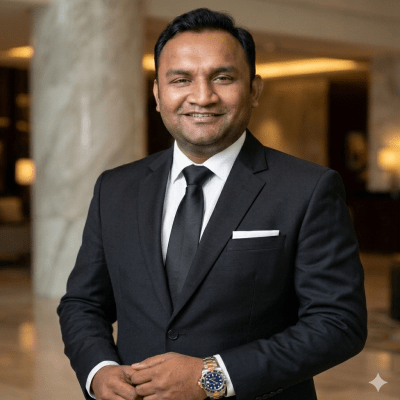
Nikunjj Jhawar is a Chartered Accountant (CA) and Chartered Financial Analyst (CFA) with nearly two decades of experience in the financial services industry. Having worked with global institutions such as HSBC and Credit Suisse in investment-related roles, he brings deep expertise in finance and markets. He is the Founder of mangopeoplenews.com, where he focuses on making complex topics in finance, markets and business accessible and relevant to everyday readers.


