

The Sweetest Deal in Real Estate Is Also One of Its Most Dangerous: What Every Homebuyer Must Know Before Signing a 'No EMI Till Possession' Offer
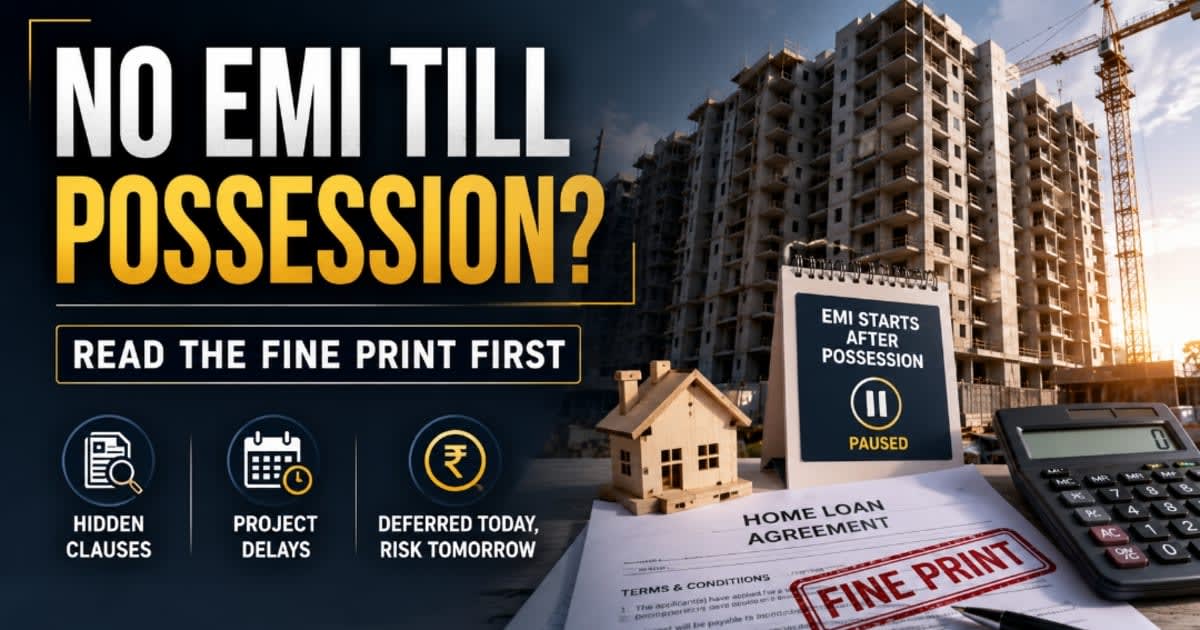
The brochure will show a young couple standing in front of a beautifully rendered apartment. The tagline will read: "No EMI till possession. Move in first, pay later." The salesperson will explain that all you need is 10–20% upfront, the bank handles the rest, and you will not pay a single EMI until you receive the keys.
It sounds, genuinely, like a dream. For a first-time buyer currently paying rent while trying to save for a down payment, the idea of deferring loan repayments by two or three years feels like the answer to a problem they had given up solving.
Before you sign anything, you need to understand exactly how this works — and why, in the wrong hands, it has financially destroyed thousands of Indian families.
WHAT 'NO EMI TILL POSSESSION' ACTUALLY IS
These schemes — technically called subvention schemes — are tripartite arrangements between the homebuyer, builder, and bank or financial institution. The bank disburses the home loan on behalf of the homebuyer directly to the builder, and the builder pays the EMIs on behalf of the buyer until possession is handed over.
The typical structure looks like this: The buyer pays 20% upfront. The bank disburses 80% of the loan to the developer. The developer pays the EMI during construction. After possession, the full EMI responsibility shifts to the buyer.
On paper, this is a three-way partnership where everyone wins. The buyer gets a payment holiday. The bank gets a pool of loan customers with minimal effort. The builder gets upfront funding to construct.
The problem is what happens when the builder does not hold up their end of the arrangement.
THE CRUCIAL DETAIL BURIED IN THE FINE PRINT
The loan agreement is between the buyer and the bank. If the developer defaults on EMI payments, the bank will recover dues from the buyer, not the developer.
Read that again. The loan is in your name. The liability is yours. The builder is merely acting as your agent in servicing the EMI — and that agency can be revoked, ignored, or simply abandoned the moment the builder runs into financial difficulty.
As many as 4.3 lakh Indians have been trapped into paying EMIs for a home they may never receive. This is not a hypothetical risk. It is a documented reality of thousands of real cases involving real families.
The biggest risk is project delays. In many cases, builders promise possession within 2–3 years but fail to deliver due to funding issues, approvals, or mismanagement. If the project is delayed, the buyer still has to start paying EMIs once the subvention period ends, regardless of whether the house is ready. Many buyers have ended up paying both rent and EMIs simultaneously, defeating the entire purpose of the scheme.
THE HIDDEN COST NOBODY TELLS YOU ABOUT
Even when everything goes according to plan — the builder pays the EMIs on time, the project is delivered without delays — there is a financial cost to this arrangement that is frequently hidden in plain sight.
Properties under subvention schemes are typically priced higher than similar units sold under standard payment plans. The builder is effectively lending you their balance sheet for two to three years. They are not doing this out of generosity. The cost of that service is built into the property price. You are paying for the convenience of deferred EMIs through a higher per-square-foot rate — often ₹3,000–5,000 per square foot more than equivalent units in the same project sold without the scheme.
When you calculate the total cost of ownership — higher property price plus the interest that accumulates on the disbursed loan during the construction period — the "no EMI" offer frequently costs you more than a standard payment plan would have.
Even if the developer pays the EMI, interest continues to accrue on the loan from the moment it is disbursed. The RBI effectively banned banks from offering these subvention schemes for this reason — though housing finance companies are still permitted to offer them.
THE REGULATORY PICTURE
The RBI has expressed concerns about subvention schemes due to the potential for misuse and financial burden on buyers. RERA has also flagged concerns about these arrangements.
The Supreme Court has ruled on multiple subvention scheme disputes — consistently holding that buyers cannot be absolved of their loan obligations simply because the builder defaulted. The legal precedent is clear and unfavourable to buyers who assumed the builder's default was the bank's problem, not theirs.
Missing an EMI can negatively impact your credit score — even if the reason is the builder's failure, not your financial inability to pay. The bank will not call the builder. It will call you.
HOW TO PROTECT YOURSELF IF YOU STILL WANT TO PROCEED
The subvention scheme is not inherently fraudulent. There are builders with strong balance sheets and clean track records who have delivered projects on time under these arrangements. The risk is not universal — it is builder-specific. Due diligence can significantly reduce exposure.
Before signing, insist on unconditional EMI payment obligation until actual possession — not just a tentative date. Require penalty clauses for builder default in EMI payments. Look for indemnity provisions protecting you from bank action due to builder default. Where possible, push for escrow-backed EMI servicing, where funds are specifically set aside for EMI payments.
Verify every detail: RERA registration, escrow accounts, and the builder's financials. Do not assume the builder is making payments — regularly track your loan account statements to ensure timely EMI servicing.
Check the builder's existing projects. How many have been delivered on time? How many are delayed by more than 12 months? The answer to that question is the single most predictive indicator of whether the subvention promise will be honoured.
Do not pay more than 15% upfront. The less you pay before possession, the less you lose if things go wrong.
THE SAFER ALTERNATIVES
Ready-to-move-in homes eliminate construction risk entirely — you know exactly what you are getting, and you start paying EMIs on an asset you already occupy. Under-construction projects with RERA registration allow you to track construction progress online and trigger penalties for delays. In cities like Bengaluru and Hyderabad, buyers who chose ready homes over subvention schemes saved an average of ₹4–6 lakh in interest and legal fees over five years, according to a 2025 study by the Indian Real Estate Society.
Construction-linked payment plans — where you pay in tranches as the building reaches defined stages — offer a middle path. You are not paying full EMIs from day one, but you also are not handing the builder 80% of the money before a single brick is laid. The bank disburses as construction progresses. Your risk is proportional to how much has been built.
THE BOTTOM LINE
"No EMI till possession" is not a lie. In the right hands — with a credible builder, a strong track record, proper RERA registration, and a legally sound tripartite agreement — it can genuinely reduce the financial burden of buying an under-construction home.
In the wrong hands, it is how ₹50 lakh savings disappear, credit scores collapse, and families spend years paying EMIs on homes they never received.
The brochure will not tell you which situation you are in. That is your job to determine before you sign.

Nikunjj Jhawar is a Chartered Accountant (CA) and Chartered Financial Analyst (CFA) with nearly two decades of experience in the financial services industry. Having worked with global institutions such as HSBC and Credit Suisse in investment-related roles, he brings deep expertise in finance and markets. He is the Founder of mangopeoplenews.com, where he focuses on making complex topics in finance, markets and business accessible and relevant to everyday readers.
