

ISRO Opened the Door. Now 400 Indian Space Startups Are Racing Through It — With ₹7,200 Crore in Their Pockets and the World Watching

The Day Everything Changed for India's Space Industry
On July 18, 2026, a rocket called Vikram-1 lifted off from Sriharikota — a small island off the coast of Andhra Pradesh where India has been launching rockets for decades. Vikram-1 climbed through the atmosphere, crossed into low Earth orbit, and successfully deployed its payload of satellites. Mission accomplished.
What made this particular launch different from every other rocket India has launched was not the technology. It was who built it.
Vikram-1 was not built by ISRO — India's government space agency that has been doing this for 60 years. It was built by Skyroot Aerospace — a startup founded in 2018 by two former ISRO engineers, Pawan Kumar Chandana and Naga Bharath Daka, working out of Hyderabad.
India's first privately built orbital rocket took its maiden flight on July 18, marking a significant step for the South Asian giant as it eyes a bigger slice of the global space economy. (CNBC)
With this single launch, India joined a very exclusive club. Only three countries have privately built rockets that have successfully reached orbit: the United States — through SpaceX, Rocket Lab, and others — China, and now India.
How Did We Get Here? The 2020 Decision That Started Everything
To understand why July 18, 2026 matters so much, you need to go back to June 2020.
That month, the Indian government made a decision that seemed technical but turned out to be historic. It formally opened India's space sector to private companies.
Before 2020, space in India was entirely a government activity. ISRO built the rockets. ISRO launched the satellites. ISRO did all the research. Private companies could participate only as suppliers of small components — they could never own or operate the main systems.
Since the government opened the space sector to private investment in 2020, over 400 startups have emerged to build a new layer of the domestic space economy.
Four hundred startups in five years. In an industry that requires some of the most advanced engineering in the world. That is extraordinary — and it happened because the government essentially said: we trust Indian entrepreneurs to build rockets, satellites, and space technology. Go do it.
The model was clearly inspired by what the United States did with SpaceX. When NASA began encouraging private rocket companies in the 2000s, most experts were sceptical. Today, SpaceX has made NASA itself dependent on private rockets for many missions. India is trying to replicate that story — and the early signs suggest it is working.
The Money Flowing In — $871 Million and Growing
Funding trends have shown an extraordinary trajectory over the last five years, escalating from a mere $43 million across 12 rounds in 2021 to a record-breaking $200 million through 53 rounds in 2025.
In simple language: in 2021, investors put just ₹360 crore into India's space startups across the whole year. By 2025, that number had grown to ₹1,680 crore in a single year. And in the first seven months of 2026 alone, startups have already garnered $113 million through 24 funding rounds.
Total funding raised by India's space startups since the sector opened: $871 million — approximately ₹7,200 crore.
Who is putting in this money? The investor base has expanded from domestic venture capital firms and angel investors to sovereign wealth funds and global institutional investors. (RS Web Solutions) Singapore's GIC — one of the world's most prestigious sovereign wealth funds — has backed Skyroot. BlackRock and Temasek have also invested. When global institutional money of this calibre enters a sector, it is a signal that the investment is serious and long-term, not speculative.
The top 10 funded companies have collectively raised more than $548 million, led by Skyroot ($150 million), Pixxel ($96 million), AgniKul Cosmos ($76 million).
Meet Skyroot — India's First Space Unicorn
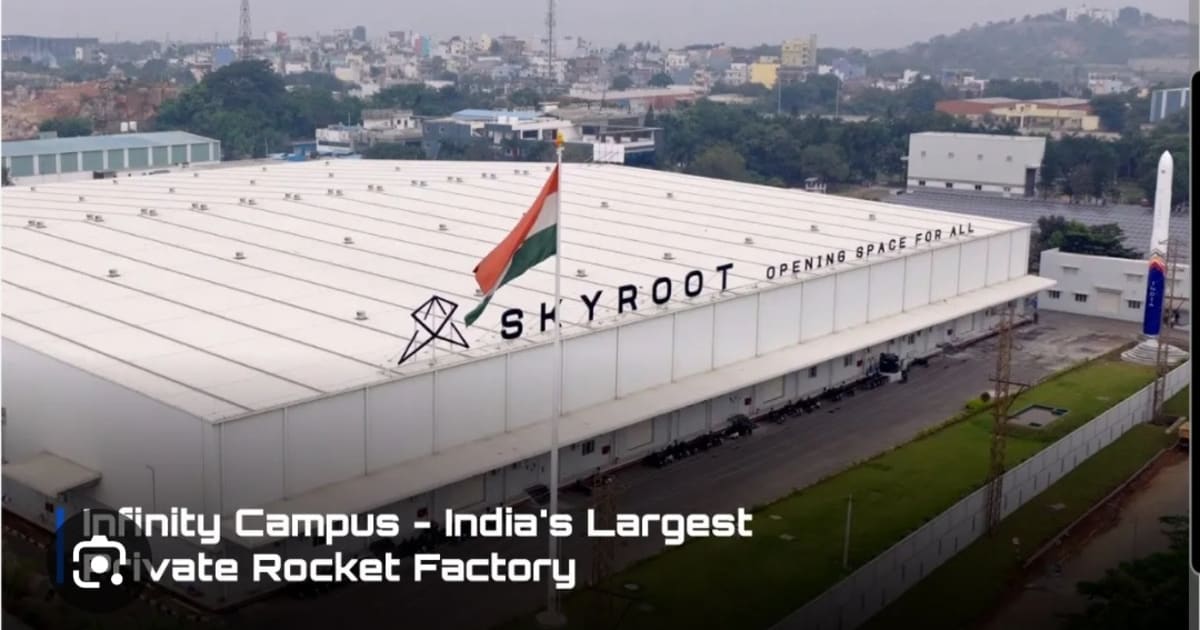
Skyroot Aerospace is the undisputed leader of India's private space revolution — and its story is worth understanding in detail.
Its $50 million Series C funding round in May has elevated its valuation to surpass $1.1 billion, positioning it as India's inaugural spacetech unicorn.
A unicorn is a startup valued at over $1 billion. In India, we have unicorns in fintech, edtech, and e-commerce. But a space unicorn — a startup worth more than $1 billion that actually builds and launches rockets — is a different order of achievement entirely.
Skyroot was founded in 2018 by Pawan Kumar Chandana and Naga Bharath Daka — two engineers who spent their careers at ISRO before deciding to start their own rocket company. They grew up watching ISRO's achievements and decided they wanted to build on that legacy — but faster, more commercially, and with the agility that private enterprise allows.
Daka said the company follows a "fail smarter and grow faster" strategy. "We had to be ultra cautious with money," and the focus was on getting "the first time right."
That caution paid off. Since its founding in 2018, the Indian space tech startup has raised just $150 million (CNBC) — remarkably little for what it has achieved. SpaceX spent billions of dollars and had multiple failed launches before achieving orbit. Skyroot achieved orbit on its first attempt, spending a fraction of what American and Chinese private rocket companies have spent.
GIC and BlackRock-backed Skyroot is planning to start commercial operations in 2027. Commercial operations means Skyroot will begin launching satellites for paying customers — companies, governments, and institutions that need their satellites delivered to specific orbits. Skyroot will compete in the sub-1,000 kg market with US-based startups such as Rocket Lab and Firefly Aerospace, and Chinese private firms.
The global market for launching small satellites is enormous and growing fast. The global space launch services market is projected to grow from $14.21 billion in 2022 to $31.90 billion by 2029. (businesswire) Skyroot is positioning itself to capture a significant share of this market — providing affordable, reliable launch services to satellite companies around the world.
The Other Stars of India's Space Startup Ecosystem
Skyroot may be the unicorn and the headline, but India's space ecosystem is much broader than one company.
Pixxel — Seeing the Earth in HD
Pixxel has raised $96 million to build a constellation of hyperspectral imaging satellites. What does "hyperspectral imaging" mean in simple terms? It means satellites that can see the Earth in extraordinary detail — not just in visible light but across hundreds of wavelengths, detecting things that the human eye and normal cameras cannot see.
This technology has applications in agriculture (detecting crop diseases before they are visible), mining (identifying mineral deposits from space), environmental monitoring (tracking pollution and deforestation), and defence (intelligence gathering). Pixxel sells this data to companies and governments who need detailed, accurate information about what is happening on Earth's surface.
AgniKul Cosmos — The World's First 3D-Printed Rocket Engine
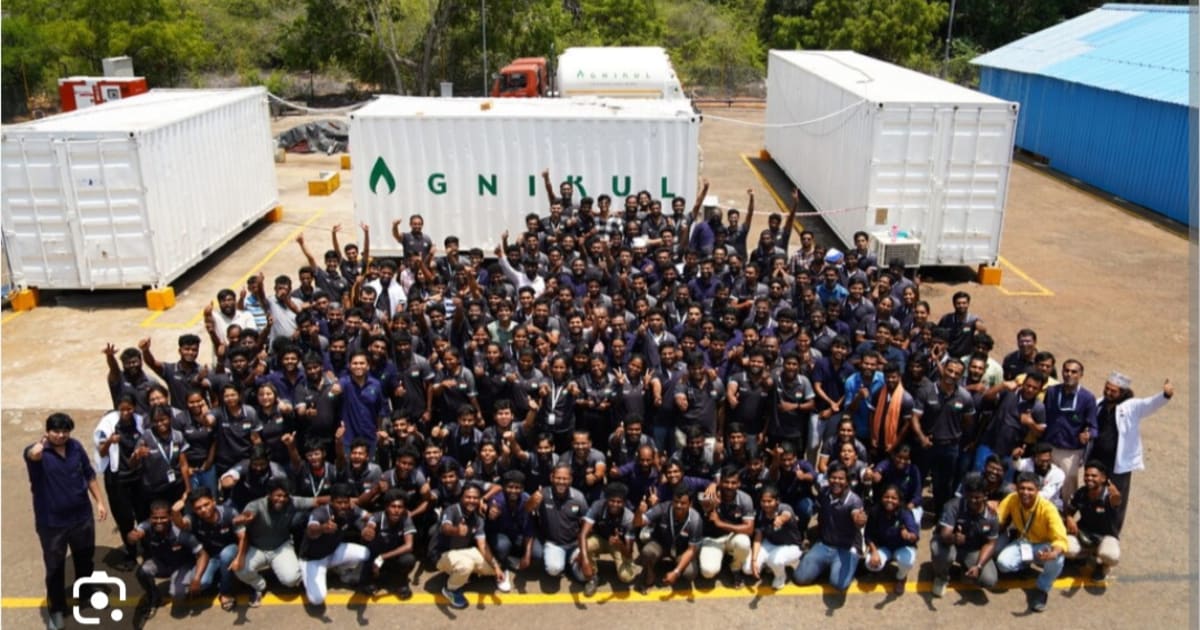
Chennai-based AgniKul Cosmos has built something the world has never seen before: a rocket with the world's first single-piece 3D-printed rocket engine — called Agnilet. This engine was designed entirely in India and manufactured using 3D printing — a process that dramatically reduces the time and cost of making rocket components.
AgniKul Cosmos raised $17 million in its ongoing Series C round. (The Core) Its rocket, Agnibaan, is designed to offer highly customised launches — meaning customers can specify exactly which orbit they want, and AgniKul will design the specific mission to get them there. This "launch on demand" capability is increasingly valuable as the satellite industry grows.
Digantara — Tracking Space Debris So Satellites Don't Crash
Here is a problem most people don't think about: space is getting crowded. There are thousands of satellites orbiting Earth, plus millions of pieces of debris from old rockets and satellites that have broken up. When a working satellite collides with a piece of debris — even a tiny screw moving at 28,000 km per hour — it can be catastrophic.
Digantara has raised $50 million to build sensors and software that track every object in low Earth orbit — giving satellite operators real-time awareness of collision risks. Digantara's $50 million Series B was one of the five largest funding rounds in India's space sector in 2025 and 2026. (Business Standard) As space gets more crowded, this "space situational awareness" service becomes more essential — and more valuable.
Bellatrix Aerospace — Powering Satellites in Space
After a rocket delivers a satellite to orbit, the satellite needs its own propulsion system to manoeuvre — to reach its exact position, avoid debris, and extend its life. Bellatrix Aerospace builds these satellite propulsion systems. Bellatrix raised $20 million in its Series A round. (Business Standard) Its customers are the satellite manufacturers who need reliable propulsion to keep their satellites working for years in orbit.
GalaxEye — Using Space for National Security
GalaxEye is building satellites with multiple sensor types — combining synthetic aperture radar (which can see through clouds and in darkness) with optical cameras to provide round-the-clock, all-weather intelligence from space. GalaxEye is focusing on providing satellite-based imagery for defence partners, highlighting the strategic dual-use nature of space technology in the current geopolitical environment.
The Geography — Why Bengaluru, Hyderabad, and Chennai Lead
Bengaluru's dominance is striking, with the city attracting $495 million across 106 funding rounds, while Hyderabad ranks second with $205 million, and Chennai trails with $80 million in funding.
This geography is not random. Bengaluru is home to ISRO's headquarters, multiple aerospace research laboratories, and a deep pool of engineering talent with aerospace experience. Hyderabad has the DRDL — Defence Research and Development Laboratory — and strong manufacturing capabilities. Chennai has Anna University and a growing aerospace manufacturing ecosystem.
These three cities together house the majority of India's space startup talent, infrastructure, and institutional knowledge. They are India's "space corridor."
The Early Stage Investment Boom — More Seeds, Bigger Future
One of the most encouraging trends in India's space funding story is what is happening at the earliest stage of investment.
Investment at the seed stage has surged from $7 million in 2022 to $62 million by 2025, while late-stage funding, which was previously negligible, reached $17 million in 2025 and $53 million thus far in 2026.
Seed funding is money given to companies that are just starting — that have an idea and a team but have not yet built anything. When seed funding grows 9x in three years, it means more new space companies are being created and more investors are willing to back them at the earliest, riskiest stage.
Late-stage funding — money given to companies that have already proven their technology and need capital to scale — growing from negligible to $53 million shows that the companies founded in the early years of the sector opening are now mature enough to attract serious institutional capital.
This progression from seed to late-stage funding is what a healthy startup ecosystem looks like. New companies start with small seed rounds, prove themselves, raise larger rounds, and eventually become large commercial businesses. India's space ecosystem is progressing exactly on this trajectory.
ISRO's New Role — Research Pioneer, Not Commercial Operator
Perhaps the most important structural change in India's space sector is what is happening to ISRO itself.
By handing off commercial activities to private firms, ISRO is able to prioritise complex research and deep-space exploration.
ISRO is one of the most accomplished space agencies in the world. Its Chandrayaan-3 mission successfully landed on the Moon's south pole — a first in human history. Its Aditya-L1 mission is studying the Sun. Its Gaganyaan human spaceflight programme is preparing to send Indian astronauts to space for the first time.
These are the kinds of missions that require ISRO's unique capabilities and government backing. But commercially launching satellites for paying customers? That does not require the nation's finest space scientists. It requires efficient operations, competitive pricing, and customer service — the strengths of private enterprise.
This division of labour — ISRO does the hard science, private companies do the commercial work — is exactly how the American model works. ISRO has embraced this transition, actively supporting private companies through facility sharing, technical mentorship, and the creation of IN-SPACe — the Indian National Space Promotion and Authorisation Centre — which acts as the regulatory and facilitation body for private space activity.
ISRO Chairman V Narayanan was present at Skyroot's Vikram-1 launch — a powerful symbolic gesture of support from the government agency for the private sector's achievement.
The Global Market Opportunity — Why Now Is the Right Time
India's private space sector is not launching into a vacuum. The global satellite and space services market is booming — and India is entering at exactly the right moment.
There is a growing global demand for launch vehicles to carry out multi-satellite missions. Russian rockets are no longer in consideration for most missions, while the commercial potential of Chinese rockets is not accepted by the West. The Ariane 6 being developed by the European Space Agency has been delayed. All these factors have opened up opportunities for India to enter this niche global satellite launch market.
In plain language: Russia's invasion of Ukraine removed Russian rockets from consideration for most Western satellite operators. Chinese rockets face restrictions from Western customers on geopolitical grounds. Europe's new rocket has been delayed. This leaves a supply gap — satellite companies with real payloads to launch and not enough reliable, Western-friendly rocket options.
India — democratic, English-speaking, politically aligned with Western countries, and now demonstrably capable of orbital launches — is the natural beneficiary of this supply gap. Skyroot's Vikram-1 success is perfectly timed to capture business from satellite operators looking for non-American, non-European, non-Chinese launch options.
This growth aims to quintuple India's 3% share of the global space economy within seven years by leveraging ISRO's legacy and commercialising satellite services for international markets.
India currently captures about 3% of the global space economy — approximately $3 to 4 billion annually. Quintupling that to 15% by 2033 would mean a $15-20 billion Indian space economy. That is an ambitious but not impossible target given the trajectory.
The Challenges India Must Overcome
Being honest is important. India's space startup success story is real — but so are the challenges.
Capital intensity: Building rockets is extraordinarily expensive. Skyroot has achieved remarkable results with $150 million — but the next phase of scaling commercial operations will require much more. Daka said following SpaceX's approach "burns a lot of cash." India's space startups will need consistent capital over many years to reach the scale of their American counterparts.
Talent: India has excellent engineers, but the specialised skills needed for rocket propulsion, satellite manufacturing, and space systems engineering are in limited supply. Training more engineers with this specific expertise is a multi-year undertaking.
Infrastructure: Launch pads, testing facilities, clean rooms for satellite manufacturing — the physical infrastructure for a large private space industry needs significant expansion beyond what currently exists.
Regulatory speed: Getting approvals from IN-SPACe, ISRO, and other authorities for new missions takes time. As the private sector scales, regulatory processes need to keep pace.
None of these challenges are insurmountable. All of them require sustained attention and investment.
What This Means for Ordinary Indians
You might wonder: I will never go to space. Why should I care about space startups?
Here are some very practical reasons why India's space industry affects your daily life — and will affect it even more in the future:
Internet everywhere.
Satellite internet — delivered by constellations of small satellites in low Earth orbit — is the technology that could finally bring reliable, affordable internet to India's rural and remote areas where optical fibre never reaches. Indian space companies building these satellites domestically will make this cheaper and more accessible for Indian consumers.
Better weather forecasts.
Indian agriculture loses billions every year to weather surprises. Better satellites mean better weather monitoring, earlier warning of cyclones and droughts, and more accurate crop advisory services for farmers.
Defence and national security.
Real-time satellite imagery of India's borders, communication systems for armed forces in remote areas, and early warning of threats — all of these depend on India having its own sovereign space capability that cannot be switched off by a foreign country.
Jobs and the economy.
India's space sector has attracted more than $500 million in total funding. That money creates high-paying engineering jobs, develops manufacturing capabilities, and generates exports — all of which strengthen India's economy.
National pride.
There is something genuinely inspiring about an Indian startup — founded by two engineers who grew up watching ISRO — building a rocket that reaches orbit on its first attempt with $150 million, while American companies spent billions reaching the same milestone. It shows what Indian engineering can achieve when given the freedom and support to try.
The Simple Summary
India's private space industry has gone from zero to extraordinary in five years. In 2020, the government opened the space sector to private companies. Today, over 400 startups are working on rockets, satellites, propulsion, earth observation, space debris tracking, and more. Together, they have raised $871 million — ₹7,200 crore — from Indian and global investors.
On July 18, 2026, Skyroot Aerospace launched India's first privately built orbital rocket — Vikram-1 — successfully delivering satellites to space. Skyroot is now India's first space unicorn, valued at over $1.1 billion.
The global opportunity is real. Russia is out of the market. Chinese rockets are unwelcome for Western customers. Europe is delayed. India — with its democratic credentials, engineering talent, and now proven orbital capability — is positioned to capture a significant share of the global satellite launch market.
The challenges of capital, talent, infrastructure, and regulation are real too. But the trajectory — from $43 million in 2021 to $871 million in total, from zero private rockets to an orbital launch in five years — suggests India is serious about space in a way it has never been before.
ISRO showed India could reach the Moon. Skyroot has shown India can commercialise space. The next chapter — 400 startups competing and collaborating to build India's piece of the global space economy — has already begun.

Nikunjj Jhawar is a Chartered Accountant (CA) and Chartered Financial Analyst (CFA) with nearly two decades of experience in the financial services industry. Having worked with global institutions such as HSBC and Credit Suisse in investment-related roles, he brings deep expertise in finance and markets. He is the Founder of mangopeoplenews.com, where he focuses on making complex topics in finance, markets and business accessible and relevant to everyday readers.
