₹37,700 Crore and Counting: Why Jio's IPO Is Really a Bet on Whether India's Biggest Telecom Story Can Become Its Biggest Tech Story
Picture India in the early days of 4G. Vodafone, Airtel, and Aircel were locked in a slow, predictable competition for customers when a new player walked in and simply gave away mobile connectivity. Free data, free calls, millions of SIM cards handed out at a pace nobody else had attempted. An entire generation of Indians got their first phone number that way, almost as an afterthought to whatever else was happening that day.
Roughly a decade later, that same company is preparing to file what could become the largest IPO in Indian stock market history.
Jio Platforms has filed its DRHP with SEBI, days after the National Stock Exchange did the same, signalling that India's primary market — subdued through much of 2026, with companies raising only around $3.5 billion through public offerings this year against more than $20 billion in each of the previous two years — is finally stirring back to life. The company is planning to issue up to 270 million new shares, a transaction expected to raise around ₹37,700 crore and value the business at roughly ₹11-12 lakh crore.
But the more interesting question isn't how big the number is. It's why a company already backed by Meta, Google, Silver Lake, KKR, and a list of the world's largest sovereign wealth funds needs to go to the public markets at all — especially when, notably, none of those existing investors are selling a single share.
A FRESH ISSUE, NOT AN EXIT
When most companies go public, a portion of the listing exists purely as an exit ramp for early investors — what's known as an Offer for Sale, where existing shareholders cash out some of their stake. The Jio IPO has none of that. Every single rupee raised flows directly onto the company's own balance sheet.
That detail matters more than it might first appear. The investors who backed Jio when it was still primarily understood as a telecom story — and who are choosing not to sell now — are effectively saying they believe the most valuable chapter of Jio's transformation is still ahead of it, not behind it.
So what is that fresh capital actually meant to fund? According to the draft filings, the single largest use of proceeds isn't AI infrastructure or data centres at all. It's debt repayment. Jio plans to use up to ₹27,500 crore to prepay or retire borrowings taken on by Reliance Jio Infocomm — including dollar- and yen-denominated loans originally raised to fund the company's network build-out, against total outstanding principal across these loans of more than ₹30,000 crore.
Think of it as a balance-sheet repair exercise that happens to come wrapped inside a record-breaking fundraise. By retiring a meaningful chunk of existing debt before deploying capital into its next phase of growth, Jio is creating financial headroom — lower leverage, lower financing costs, and more flexibility to invest aggressively in AI infrastructure and data centres without piling fresh debt on top of old debt. It's arguably one of the more disciplined design choices buried inside an otherwise enormous headline number.
THE SUBSCRIBER RACE IS OVER. NOW COMES THE HARDER PART.
Here's the uncomfortable truth sitting at the centre of this IPO: Jio's days of growth through sheer subscriber addition are essentially behind it. With 524.4 million users already on its network, the company has nothing meaningful left to gain by chasing yet another wave of first-time mobile customers. That race has been run, and Jio won it decisively.
Telecom businesses typically move through three distinct phases — building the network, acquiring subscribers, and finally, monetising what you've built. Jio spent the better part of the last decade completing the first two, pouring money into spectrum, fibre, transmission infrastructure, and customer acquisition at a scale no Indian company had ever attempted. The result is unmatched reach. What it hasn't yet fully proven is the third phase.
This is where the scale of Jio's subscriber base becomes genuinely interesting from an investment standpoint, rather than just impressive on a slide. Analyst estimates suggest that even a modest ₹10 increase in monthly average revenue per user across Jio's base could translate into roughly ₹6,000 crore of additional annual profit. The most capital-intensive, cash-burning phase of building this business is largely done. Network infrastructure exists, customer acquisition costs have normalised, and going forward, revenue growth has a real shot at flowing through to the bottom line rather than straight back into capex.
That said, telecom history is littered with operators who built dominant market share and then struggled for years to translate that dominance into pricing power. Scale is an asset. It is not, on its own, a guarantee.
This is precisely where Jio's broadband business becomes strategically important — not just as a revenue line, but as the on-ramp into everything else the company wants to sell. Jio has positioned itself as a leading player in fixed wireless access, using 5G networks to deliver home broadband without the cost of laying fibre to every doorstep. Broadband customers tend to generate higher revenue, stick around longer, and are considerably more likely than mobile-only users to pick up additional services. Bundle in entertainment, cloud storage, smart-home tools, and enterprise offerings, and a broadband connection stops being just a product and starts becoming a gateway into the rest of Jio's ecosystem. Investors evaluating this IPO will likely care less about how many new SIM cards Jio sells next year, and far more about how many separate services the average customer eventually adopts.
WHAT YOU'RE ACTUALLY PAYING FOR
Here's where the valuation debate gets genuinely complicated, and where reasonable people can land on very different conclusions.
At a price tag of ₹11-12 lakh crore, investors aren't simply buying into Jio's existing telecom cash flows. The overwhelming majority of Jio's revenue today — 77% of consolidated operating revenue — still comes from the traditional telecom business: mobile subscriptions, JioFiber broadband, and enterprise connectivity. Digital services like content subscriptions and cloud offerings exist, and they're growing, but right now they remain a comparatively small slice of the total pie.
And that creates a real dilemma for how the market is supposed to price this thing. Telecom companies, however dominant, rarely command the kind of valuation multiples that software and technology businesses enjoy. Investors treat telecom operators almost like regulated utilities — companies that need a bottomless well of capital expenditure, that must periodically pay enormous sums for spectrum, and that face relentless pressure to keep upgrading infrastructure just to stand still. Even the most successful telecom operators on the planet have struggled to command tech-style premiums.
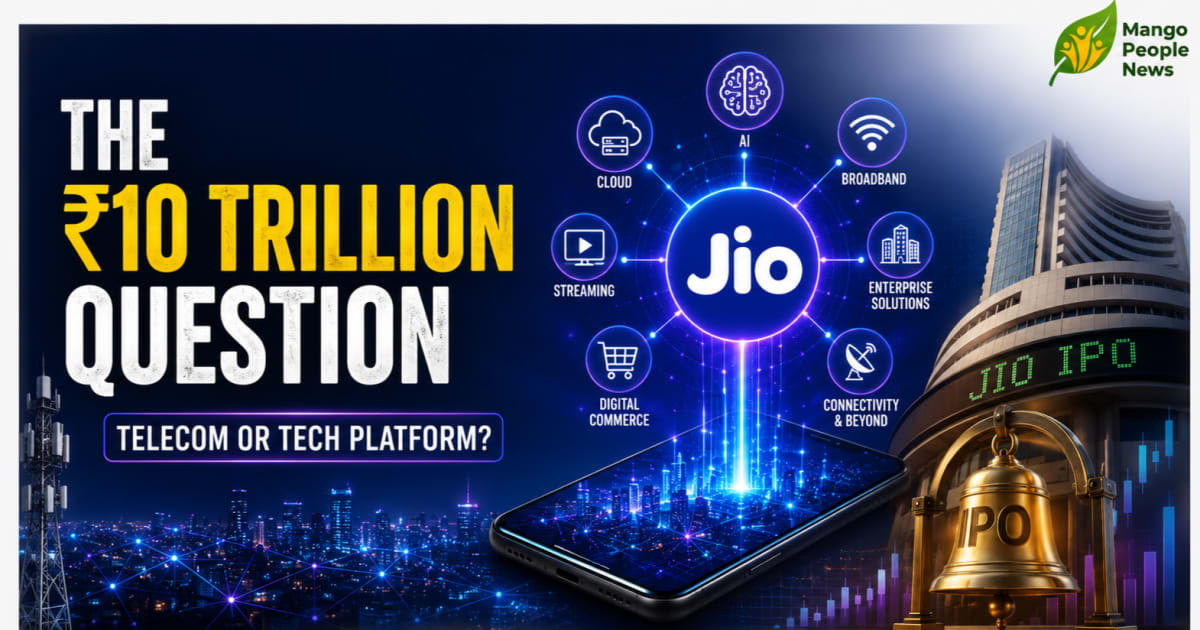
Jio's management clearly wants the market to look past that ceiling. The company has spent the past year increasingly framing itself not as a phone network with some side projects, but as the foundation of a much larger digital-infrastructure strategy — one spanning AI, cloud computing, enterprise software, data centres, satellite connectivity, and digital commerce. At Reliance's most recent annual general meeting, leadership positioned artificial intelligence as one of the conglomerate's primary engines of future growth.
That positioning puts Jio in an unusual middle ground. Its current earnings are still overwhelmingly driven by telecom economics. But few telecom operators anywhere in the world combine Jio's scale, its balance-sheet backing, and its sheer ecosystem reach. Reliance's pitch, in essence, is that the network itself should be viewed not as the business, but as the foundation on top of which several future businesses get built — and that investors should be willing to pay something for that optionality today, even before all of those future businesses have fully matured.
The risk in that pitch is obvious. The market right now is crowded with companies attaching themselves to the AI narrative without much to show beyond the narrative itself. The burden sits squarely on Reliance to demonstrate, in subsequent quarters, that its AI and digital infrastructure bets are translating into real, measurable businesses — not just slides in an investor deck.
THE REAL STORY ISN'T ABOUT JIO. IT'S ABOUT RELIANCE.
Step back far enough, and the most important thing about this filing has very little to do with telecom tariffs or subscriber counts at all.
For years, Reliance has been asking public market investors to look past its legacy oil-to-chemicals business and recognise the value quietly being built across telecom, retail, technology, and energy. The market has remained sceptical — not necessarily because those businesses lacked merit, but because they all sat bundled together inside one sprawling corporate structure, with no clean, independent way to price any single piece of it.
Jio's listing changes that dynamic for the first time. Once it trades publicly, investors finally get a transparent, market-determined price for what is arguably the single most valuable digital asset Reliance has built over the last decade. And that price won't stay contained to Jio alone — it will inevitably ripple into how the market thinks about Reliance Retail, the group's AI initiatives, and its emerging energy businesses, each of which has spent years sitting inside the same opaque conglomerate structure.
The fact that this is a 100% fresh issue, with zero shares being sold by existing backers, reinforces exactly that interpretation. This isn't current shareholders heading for the exit while the going is good. It's Reliance deliberately creating an independent valuation benchmark for one of its crown jewels, while holding onto every bit of ownership in what it clearly considers a long-term strategic asset rather than a cash-out opportunity.
THE COMPETITION THAT ACTUALLY MATTERS
On paper, Jio has several rivals. In practice, there is exactly one that matters: Airtel.
Vodafone Idea remains weighed down by severe financial constraints and continues losing ground. BSNL keeps attempting a comeback but remains a distant third on both network quality and subscriber economics. Airtel, however, has run a fundamentally different playbook from Jio's from the very start — rather than chasing sheer scale and affordability to win hundreds of millions of users the way Jio did, Airtel leaned into premium customers, higher average revenue per user, enterprise services, and notably disciplined capital allocation. The result is a company that, despite a smaller subscriber base than Jio, posts stronger profitability metrics on several measures.
That contrast sets up the central question every prospective investor in this IPO eventually has to answer for themselves: is Jio fundamentally a telecom company locked in a permanent, grinding battle with Airtel for market share — or is it an emerging digital infrastructure platform that simply happens to use its telecom network as the world's most efficient customer acquisition engine? There is no objectively correct answer here. How you answer it will, more than any single financial metric in the prospectus, determine what you think this business is actually worth.
WHERE THIS LEAVES INVESTORS
For anyone studying the prospectus, the question worth asking isn't whether Jio can convince another million Indians to activate a SIM card. That chapter of the story is mature, largely finished, and was never really the point of this listing anyway.
The real test is whether Jio can complete the harder, less certain pivot — from India's dominant telecom network into the country's premier digital infrastructure platform. Pull that off convincingly, and the market eventually stops measuring Jio against Airtel altogether and starts benchmarking it against the world's largest technology companies instead. That repricing, if it happens, would be one of the more consequential shifts in Indian capital markets in years.
Jio spent a decade quietly building networks, platforms, and entirely new lines of business under the shelter of a private conglomerate structure. What it's asking the public markets to do now is put an actual price on all of that — and decide, for the first time with real money on the table, whether the bet on becoming something bigger than telecom was worth making.

Nikunjj Jhawar is a Chartered Accountant (CA) and Chartered Financial Analyst (CFA) with nearly two decades of experience in the financial services industry. Having worked with global institutions such as HSBC and Credit Suisse in investment-related roles, he brings deep expertise in finance and markets. He is the Founder of mangopeoplenews.com, where he focuses on making complex topics in finance, markets and business accessible and relevant to everyday readers.