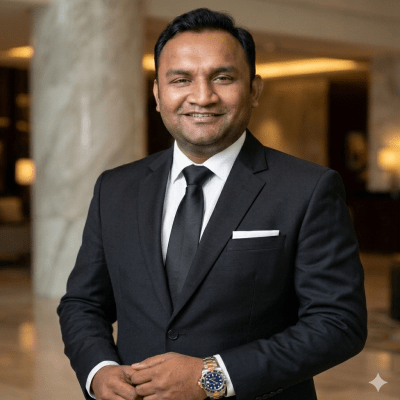
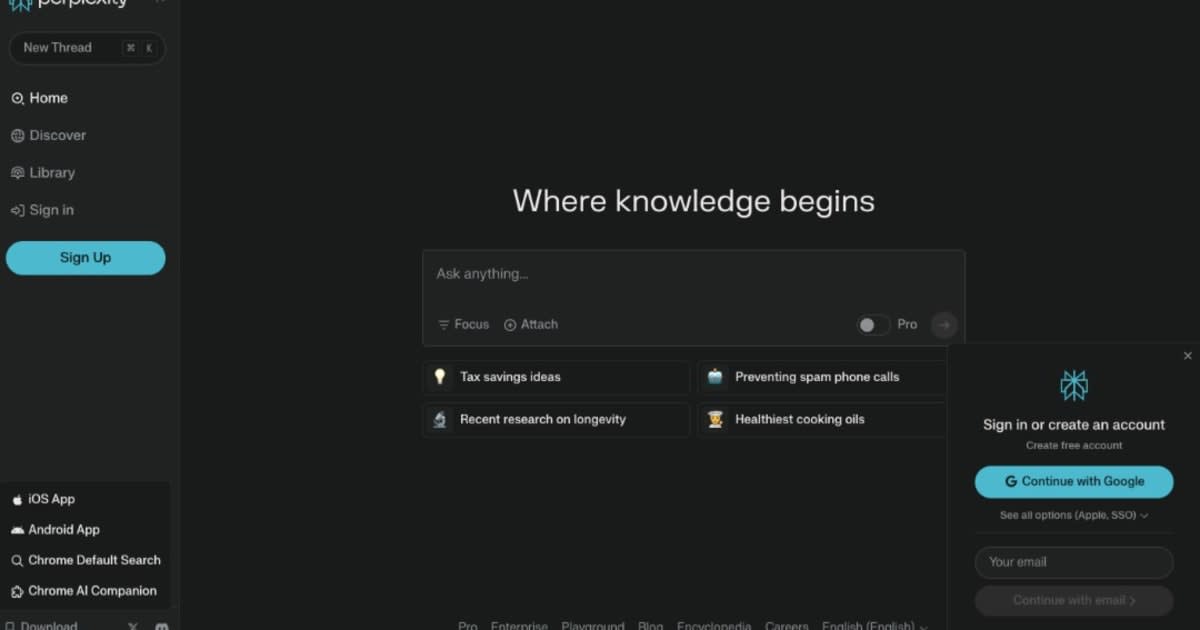
There is something almost paradoxical about Aravind Srinivas. He is, by any conventional measure, a Silicon Valley success story — a $21 billion company, India's youngest billionaire, backed by Jeff Bezos and Nvidia, with a product that genuinely threatens Google's 25-year stranglehold on internet search. And yet, when he speaks about ambition, his gaze keeps returning home. To Chennai. To India. To what he believes is a generation of builders waiting for its moment. That moment, he is convinced, is now.
FROM THE STREETS OF CHENNAI TO THE SUMMIT OF SILICON VALLEY
Aravind Srinivas was born in Chennai in 1994 into a middle-class family. His father was a retired banker. His mother used to point at the IIT Madras campus near their home and tell young Aravind that was where he was going to study. He delivered — spectacularly, graduating as the dual-degree topper in electrical engineering from one of India's most selective institutions.
What followed was a trajectory that reads less like a career plan and more like a masterclass in obsessive curiosity. He earned a PhD from UC Berkeley, specialising in reinforcement learning, contrastive learning, and deep learning models, before going on to work at three of the most important AI research organisations in the world: OpenAI, Google Brain, and DeepMind. Few people anywhere on the planet can claim that CV.
In the autumn of 2022, with ChatGPT still weeks away from its world-altering debut, Srinivas left his role at OpenAI to co-found a new company with three collaborators. The exact mission was initially uncertain — until their own prototype clarified it. The product simply answered questions better than anything else they had used. That was enough. Perplexity AI was born with a single animating idea: replace the list of links with a direct answer.
PERPLEXITY TODAY: THE NUMBERS BEHIND THE NARRATIVE
Three years later, the company Srinivas built from a fuzzy premise has become one of the most closely watched startups in the world.
As of early 2026, Perplexity AI reached a valuation of $21.21 billion following its Series E-6 funding round, having raised over $1.72 billion in total from more than 56 investors — including Jeff Bezos, Nvidia, SoftBank, Databricks, and notably, Google's own Chief AI Scientist. The last name on that list says everything about how seriously the search incumbent is taking the upstart.
Revenue growth has been equally striking. Perplexity went from $100 million to $500 million in annual recurring revenue while growing its team by only 34% — a capital efficiency ratio that most startups can only dream of. By mid-2025, the platform was processing 780 million queries per month, up from 230 million a year earlier — a 240% jump — with month-on-month growth consistently above 20%.
In February 2026, Perplexity also made the significant decision to transition away from AI-integrated advertising toward a subscription-first model, with leadership stating the move was intended to protect user trust in what the company calls its "answer engine."
INDIA: THE WORLD'S BIGGEST PERPLEXITY MARKET
Here is the detail that perhaps best explains Srinivas's deep emotional investment in India's future: his home country is now Perplexity's single largest user base in the world. India emerged as Perplexity's biggest market by user numbers following its strategic partnership with telecom giant Bharti Airtel, part of the company's broader carrier strategy it has deployed in several countries. The results were extraordinary. India delivered 640% year-over-year user growth, proving that demand for AI-powered search in price-sensitive, high-aspiration markets is as powerful as — if not stronger than — in wealthy Western ones.
The reasons are structural, not incidental. India combines internet costs among the lowest globally with a population where over 65% of people are under 35 — highly adaptable to new technologies and generating diverse use cases from students preparing for competitive exams to professionals streamlining complex workflows.
Srinivas sees all of this not merely as a business opportunity but as a validation of something he has believed for years: that India is no longer a passive consumer of global technology. It is increasingly an active co-creator of it.
PLANS FOR INDIA: FUND, ENGINEERING HUB, AND DEEPER ROOTS
Perplexity's India ambitions are becoming concrete and institutional, not just rhetorical.
Srinivas has confirmed that Perplexity is evaluating the establishment of a dedicated engineering presence in India, with Bengaluru and Hyderabad both under consideration. He has specifically cited India's deep pool of backend and infrastructure talent as a key draw. Beyond that, the company is planning a dedicated Perplexity fund in India — a vehicle to back local AI startups and deepen its engagement with the Indian entrepreneurial ecosystem.
The India strategy also encompasses setting up AI integration across sectors like healthcare, fintech, and education — industries where AI can compound its impact at a scale that no other country outside China can match.
This is Srinivas thinking not just as a CEO protecting a market share, but as an alumnus wanting to reshape what the next generation of Indian entrepreneurs builds and who backs them.
"FAR MORE BUSINESSES WILL BE CREATED IN INDIA"
At the heart of Srinivas's worldview is a conviction that is equal parts optimistic and urgent: the conditions for mass entrepreneurship in India have never been more favourable — and AI is the accelerant that will make the next decade look nothing like the last.
The infrastructure has arrived. Digital public goods — from UPI to Aadhaar to the Open Network for Digital Commerce — have lowered the floor for building businesses to a level that didn't exist even five years ago. Venture capital, once concentrated in Mumbai and Bengaluru's elite circles, is becoming more distributed. And now, the tooling revolution that AI represents means that a team of five people in Coimbatore or Indore can build something that would have required fifty people and significantly more capital in 2018.
Srinivas has gone further, arguing that the wave of AI-related job displacement in traditional sectors is something to view with cautious optimism rather than fear — suggesting that it frees people from roles they didn't find meaningful and pushes them toward building things of their own. For a country where entrepreneurship has historically been constrained by risk aversion — the pressure to choose a "safe" career over an uncertain one — this is a profound cultural shift in the making.
India's AI talent pool, in Srinivas's assessment, is among the strongest in the world. The country has the capability to move from being primarily a consumer of global AI products to a genuine builder of AI tools that solve both local and global problems. The pieces — talent, infrastructure, capital, market — are finally all present simultaneously.
THE BIGGER QUESTION: CAN INDIA PRODUCE THE NEXT PERPLEXITY?
Srinivas's own story is the most persuasive argument he can make. A boy who grew up in Chennai, in a family more familiar with banking than technology, who chose an unconventional path and found himself at the frontier of the most consequential technological shift in a generation. The story isn't about genius in isolation — it is about what becomes possible when curiosity meets the right environment.
What he is suggesting, implicitly, is that India is becoming that environment. Not fully. Not without friction. But directionally, unmistakably, it is moving there.
Srinivas has described Perplexity's original genesis as a small business tool that its own four-person founding team built for themselves — with no revenue and AI at their fingertips. The pivot to becoming a platform for entrepreneurs and founders was, in his words, a full circle. Founders are using it to build companies that matter. The tool built by someone who left India came back to India — and found its biggest audience here.
If that isn't a metaphor for the moment Srinivas is describing, it is hard to know what is.
India's next wave of business creation, he believes, won't look like the last one. It won't be built on outsourcing contracts or feature-phone distribution. It will be built on AI, on speed, on a generation that grew up using smartphones and expects to build on them. The question is no longer whether India will produce world-class companies. The question is just how many — and how fast. If Aravind Srinivas is right, the answer will surprise everyone.