From 120 Hotels to 250: How Royal Orchid's Asset-Light Playbook Is Quietly Making It One of India's Fastest-Growing Hospitality Companies
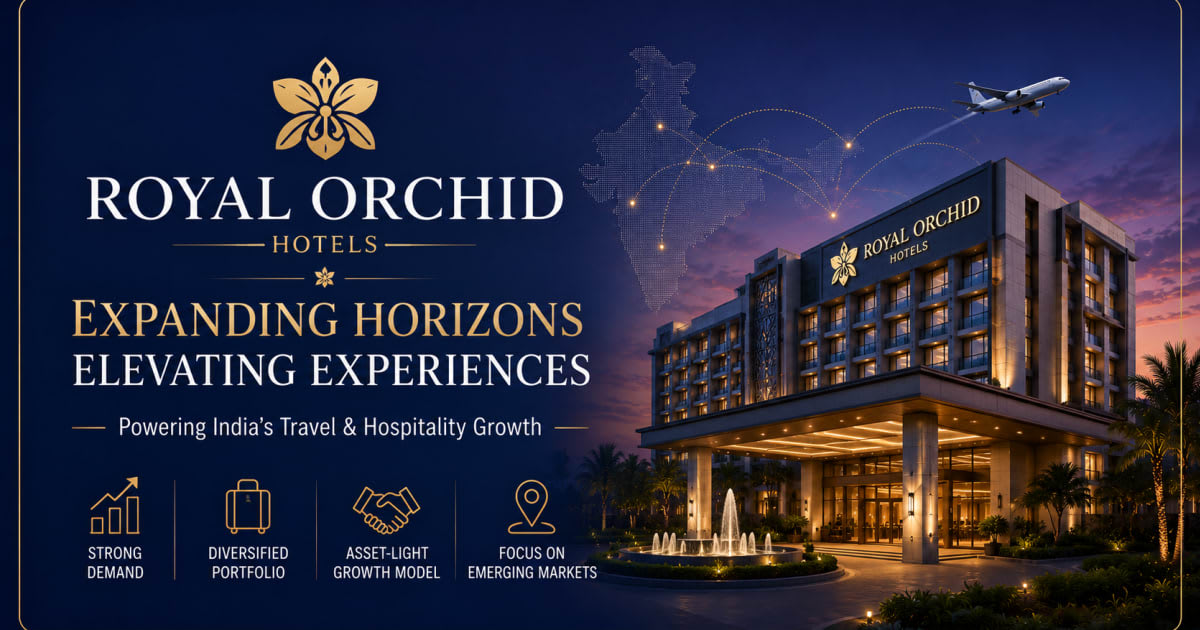
India's hotel industry is in the middle of its most sustained demand cycle in decades. Domestic travel is growing, corporate travel is recovering, destination weddings are booming, and the government is actively redirecting outbound tourism inward. In this environment, the companies with the most strategic clarity — the ones that know exactly which segment they are targeting and exactly how to expand without overleveraging their balance sheets — are pulling away from the pack.
Royal Orchid Hotels is one of those companies. And its plan to add 50 new hotels leveraging India's domestic travel boom is the clearest articulation yet of a strategy that is working better than its relatively modest market profile suggests.
THE BUSINESS: 120 HOTELS, 10,700 KEYS, AND A BRAND ARCHITECTURE THAT COVERS EVERY WALLET
Royal Orchid Hotels currently operates over 120 hotels across India — spanning 168 properties with 10,700 keys across its multi-brand portfolio. The brand architecture is one of the company's most underappreciated strategic assets: Royal Orchid for upper-upscale urban and resort properties, Regenta for midscale city hotels, Regenta Place for leisure destinations and nature resorts, Regenta Inn for economy business travellers, and the newly launched Regenta Z for the value-smart economy segment.
That five-brand ladder covers every price point from ₹2,000 per night to ₹15,000+ — allowing Royal Orchid to capture a traveller at their first business trip and serve them across every lifecycle stage, from budget economy to premium leisure. The breadth is not just a marketing convenience. It is the engine of the company's asset-light model, because different franchisees and owners are attracted to different tiers.
THE 50-HOTEL ADDITION: WHERE GROWTH IS ACTUALLY COMING FROM
The 50 new hotels being added in the current cycle are already in the pipeline — not aspirational targets. The company has a signed pipeline of 52 hotels comprising approximately 3,600 rooms as of the Q4 FY26 earnings call. These are management contracts, franchise agreements, revenue share arrangements, and flexi lease deals — almost none of them require Royal Orchid to deploy its own capital into bricks and mortar.
The destinations reveal the demand thesis. New hotels in Mumbai and Gurgaon signal strengthening corporate and GCC-driven demand in India's two largest commercial hubs. Regenta Place in Jim Corbett — one of India's most visited wildlife destinations — reflects the leisure travel boom that has made nature and wildlife tourism one of hospitality's fastest-growing categories. Regenta Place Udaipur, a 43-room wedding-focused property with a 7,000 sq ft banquet hall and 30,000 sq ft outdoor space, reflects the domestic wedding market redirected from international venues. Vision 2030 targets 250 hotels and 20,000 keys — more than doubling both metrics from today.
THE FINANCIAL PICTURE: GROWING FAST WITHOUT GROWING RECKLESSLY
Royal Orchid Hotels reported consolidated Q3 FY26 revenue of approximately ₹117.93 crore, up significantly year-on-year, with strong EBITDA and profit growth driven by portfolio expansion, operational efficiencies, and rising demand across business and leisure travel segments.
For Q1 FY26, consolidated revenues grew 8% year-on-year, net profit after associates increased 28% year-on-year, room revenue grew 6%, and food and beverage revenue increased 7%. The balance sheet picture is equally encouraging. The company has around ₹100 crore in cash equivalents and bank borrowings of ₹91 crore — essentially net cash neutral. The company can become debt-free if needed but prefers to use funds for expansion — a statement that reflects exactly the kind of disciplined capital allocation that separates sustainable hotel operators from those that grow into financial distress.
The Regenta Z economy brand — targeting the ₹1,500–2,500 per night segment — is the newest strategic initiative. The company plans to add roughly 120 Regenta Z hotels under Vision 2030 , targeting the value-smart economy traveller segment that currently has limited branded supply outside the top 8 cities.
THE DOMESTIC TOURISM TAILWIND: PM MODI'S STATEMENT AS CATALYST
Prime Minister Modi's recent appeal to Indians to defer foreign travel for a year — directing spending toward domestic leisure destinations — is the external catalyst that the domestic hotel industry was not expecting but will benefit from substantially.
Royal Orchid's asset in this context is its Regenta Place leisure portfolio: Regenta Place Corbett, Regenta Place Udaipur, and multiple nature and wildlife properties that sit at the intersection of luxury leisure and accessible domestic destinations. Indian families redirecting a Bali or Maldives holiday to Corbett, Udaipur, or Coorg are precisely the customers these properties are designed for.
The mix shift toward leisure — away from pure business travel — also benefits Royal Orchid's F&B revenues, which carry higher margins than room revenues in well-operated leisure properties. Destination wedding revenue is particularly high-margin: a single 3-day wedding at a Regenta Place with 200 guests generates revenue equivalent to months of standard occupancy at similar properties.
THE GLOBAL PARTNERSHIP QUESTION
Royal Orchid Hotels is open to partnering with global brands on the lines of Marriott and Accor in India, as it expands its portfolio to 20,000 keys across 250 hotels by 2030. President Arjun Baljee said the company's decision to partner would be determined by the value it would bring to shareholders.
A global brand partnership — whether a franchise arrangement with Marriott's Courtyard, Accor's Novotel, or IHG's Holiday Inn Express — would provide Royal Orchid with international distribution reach, loyalty programme access, and the OTA pricing power that comes from a globally recognised brand. The trade-off is the royalty fees and brand standards compliance that reduce the economics per managed key.
The openness to explore this — rather than insisting on purely building the Regenta brand — suggests management is prioritising shareholder value over brand ego. That is the right instinct for a company at Royal Orchid's stage.
WHAT TO WATCH
The Vision 2030 pipeline of 52 signed hotels is the most concrete deliverable to track. Watch whether the pace of hotel openings — currently targeting over 1,800 new keys in six to nine months — accelerates or slips. Execution in the asset-light model depends on franchisees and management agreement partners meeting their construction and opening timelines, which in India's regulatory environment can be unpredictable.
The Regenta Z launch is the most strategically consequential new initiative. 120 Regenta Z hotels by 2030 would transform the company's room count overnight — but only if the product-market fit in the ₹1,500–2,500 night segment is right. Early occupancy and RevPAR data from the first Regenta Z openings will reveal whether the economy brand resonates or whether it needs significant iteration.
RevPAR trajectory is the financial metric that matters most. Royal Orchid's managed properties improve their profitability contribution to the group as RevPAR grows — fixed management fees are supplemented by incentive fees as hotel performance improves. Watch whether the broader India midscale RevPAR momentum holds through FY27.
THE BIGGER PICTURE
India's hotel room supply is among the lowest per capita of any G20 economy — approximately 1.5 branded hotel rooms per 1,000 population, versus 5–8 in comparable economies. That structural undersupply, combined with rising domestic travel demand and government-directed redirection of outbound travel, creates the most favourable demand backdrop for domestic hotel operators in a generation.
Royal Orchid's Vision 2030 plan — 250 hotels, 20,000 keys, asset-light expansion across every price tier — is the right strategy for this moment. The company that once operated primarily in Bengaluru and a handful of business cities is now building a genuinely national footprint from Jim Corbett to Udaipur to Gurgaon to Mumbai.
It is not the most glamorous growth story in India's hospitality sector. It does not have the brand recognition of Taj or the financial scale of IHCL. But it is growing systematically, managing its balance sheet conservatively, and positioning for exactly the demand tailwinds that India's domestic travel boom is creating.
Fifty new hotels. Three thousand six hundred new keys. And the most favourable structural backdrop in decades. That combination, for patient investors, is the story worth watching.

Nikunjj Jhawar is a Chartered Accountant (CA) and Chartered Financial Analyst (CFA) with nearly two decades of experience in the financial services industry. Having worked with global institutions such as HSBC and Credit Suisse in investment-related roles, he brings deep expertise in finance and markets. He is the Founder of mangopeoplenews.com, where he focuses on making complex topics in finance, markets and business accessible and relevant to everyday readers.