Beyond American AI: Inside Sarvam AI’s $275 Million Plan to Build Artificial Intelligence for Everyday India
When foreign tech giants like OpenAI (creators of ChatGPT), Google, and Anthropic build artificial intelligence, they build it primarily for English-speaking Western users. While these tools can translate into Indian languages, they often struggle with local dialects, misinterpret everyday Indian contexts, and cost significantly more money to run when processing scripts like Hindi, Tamil, or Telugu.
Bengaluru-based startup SARVAM AI was founded in 2023 to solve this exact problem. Founded by AI researchers Vivek Raghavan and Pratyush Kumar, the company set out to build India's own "sovereign AI"—technology built inside India, trained on Indian data, and priced for the Indian market.
Having raised over $275 million (around ₹2,300 crore) from major venture capital firms like Peak XV Partners and Lightspeed, Sarvam has rolled out a full suite of AI products designed to bring voice technology, document processing, and language tools to millions of everyday citizens and businesses.
Here is a deep-dive breakdown of Sarvam AI’s product stack, how they solved the "Indic language problem," and why their voice-first technology matters for the common person.
The Hidden Problem: Why Foreign AI Is Expensive and Inaccurate for India
To understand what Sarvam is doing, you first have to understand why foreign AI models fail the everyday Indian user.
The "Token" Problem (Why Hindi Costs 4x More)
Artificial intelligence models do not read full words. Instead, they chop text into tiny pieces called tokens.
In English, a common word like "hospital" is treated as a single token.
In Hindi or Tamil, because foreign AI models were not built for Indic scripts, the same word might get broken down into 4 or 5 separate tokens.
Because foreign AI companies charge users based on the number of tokens processed, a business using AI in Hindi or Marathi ends up paying up to four to five times more money for the exact same sentence than a business operating in English!
The Voice and Dialect Barrier
In India, millions of citizens use smartphones primarily through voice—sending WhatsApp audio notes rather than typing long messages. Foreign AI voice assistants are trained on American or British accents. When an Indian user speaks in conversational Hindi mixed with English words ("Hinglish") or uses regional slang, foreign AI assistants routinely misunderstand the request.
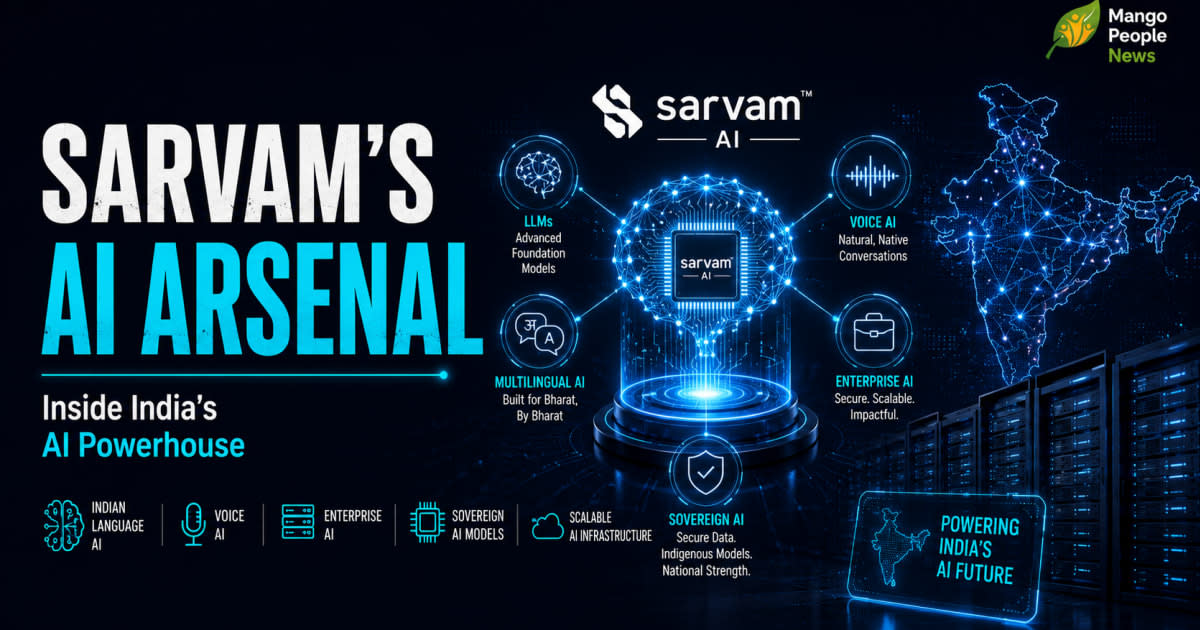
Unpacking "Sarvam’s AI Arsenal": A Full Product Breakdown
To solve these barriers, Sarvam built a complete stack of interconnected tools designed for low-cost, high-speed execution.
Sarvam Agents (Conversational Voice Bots)
Sarvam created automated voice agents capable of handling real-time, two-way telephone calls and WhatsApp voice interactions in 10 major Indian languages (including Hindi, Bengali, Tamil, Telugu, Kannada, Gujarati, and Marathi).
How it works for the common person: A bank, healthcare clinic, or small logistics business can deploy a Sarvam voice bot to call customers. The bot can answer questions about loan status, confirm delivery times, or schedule doctor appointments in natural regional languages.
Low Latency: Sarvam engineered its system so the AI responds in under one second, making the telephone conversation feel like talking to a real human being rather than a clunky automated machine.
Bulbul (Natural Text-to-Speech Engine)
Most computer-generated voices sound robotic, stiff, and unnatural. Sarvam’s voice generator, Bulbul, turns written text into audio that includes real Indian accents, natural pauses, and correct pronunciations of local place names and personal names. This allows news outlets, educational apps, and audiobooks to convert written articles into clear, natural audio for listeners.
Sarvam 2B & Sarvam-1 (Small, Efficient AI Brains)
Instead of trying to build giant, energy-guzzling AI models that require thousands of expensive computer processors, Sarvam built smaller, highly specialized models like Sarvam 2B.
These models are trained heavily on Indian languages, culture, and government data.
Because the model is smaller, Indian companies can run it on far cheaper servers, bringing down the monthly cost of AI usage for local startups and small shopkeepers.
Sarvam Vision (Reading Indian Documents and Invoices)
In India, millions of business documents—such as handwritten shop bills, truck transport slips, government identity cards, and property records—are written in regional languages or handwritten. Foreign AI tools fail to read these documents accurately. Sarvam Vision is built specifically to scan, digitize, and extract text from complex Indian documents, automating paperwork for small businesses.
A1 (Specialized Legal Assistant)
Sarvam also designed industry-specific tools. Their A1 legal assistant allows Indian lawyers and legal clerks to search through decades of Supreme Court and High Court judgments, draft legal notices, and summarize complex case files in seconds.
Financials and Market Strategy: How Sarvam Plans to Survive
Building artificial intelligence requires buying expensive computer hardware (GPUs) and hiring top-tier engineering talent.
According to financial filings from Inc42 Datalabs, Sarvam’s revenue grew by 162% in FY25 to reach ₹29.1 crore (up from ₹11.1 crore in FY24). However, because the company is investing heavily in computing infrastructure, it recorded a net loss of ₹102.4 crore in FY25.
The Business Model
Sarvam operates on a pay-as-you-go API model. Businesses pay a tiny fraction of a rupee for every minute of voice call handled or every page of text translated. By undercutting the pricing of Western tech giants while delivering higher accuracy in Indian languages, Sarvam aims to become the default "AI utility provider" for Indian enterprises, government departments, and tech startups.
Why "Sovereign AI" Matters for India’s Future
Beyond business profits, Sarvam’s technology represents an important national milestone.
If India relies entirely on foreign AI infrastructure, sensitive financial, legal, and citizen data ends up being processed on foreign cloud servers. Furthermore, if foreign companies decide to raise prices or restrict access, Indian businesses could get locked out of vital digital tools.
By building and hosting AI models physically inside India, Sarvam ensures that:
Data Privacy: Sensitive customer data stays safely within national borders under Indian law.
Cultural Preservation: Local languages, folk traditions, and regional history are preserved and accurately represented in modern software.
Affordability: Local technological independence keeps digital tools affordable for the common person, rather than a luxury reserved for wealthy corporations.
The Bottom Line
Sarvam AI proves that India does not have to remain a passive consumer of foreign technology.
By building artificial intelligence that speaks our languages, understands our accents, and fits our local budgets, Sarvam is helping bridge the digital divide—ensuring that the AI revolution benefits everyday citizens, shopkeepers, and workers across the country.

Nikunjj Jhawar is a Chartered Accountant (CA) and Chartered Financial Analyst (CFA) with nearly two decades of experience in the financial services industry. Having worked with global institutions such as HSBC and Credit Suisse in investment-related roles, he brings deep expertise in finance and markets. He is the Founder of mangopeoplenews.com, where he focuses on making complex topics in finance, markets and business accessible and relevant to everyday readers.